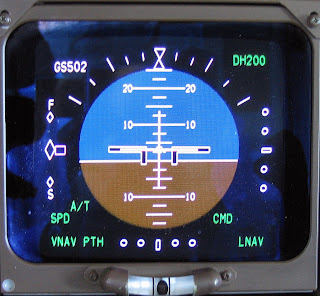
I was talking to a friend years ago, a friend who happens to also be the owner/pilot of a Cessna 421, about some flying experience I had had, something involving the L-1011, and the story involved the flight director (FD). I’ve long since forgotten the details of the story, but I’ve never forgotten his response, because he said, “Do you use that flight director thing often?”
I was puzzled and even a little astonished by his question. I used it all the time—every 1011 pilot does. Not having a flight director—flying on “raw data” (basic altitude, airspeed, pitch, roll, rate of climb, and nav position data) is practically an abnormal situation for a 1011. A 1011 pilot— any turbine aircraft pilot, really—will almost certainly fly a couple of raw data approaches in initial training, and a raw data approach is sometimes one of the discretionary items for review in annual training, but normally, meaning 99.9% of the time, flying a jet aircraft means flying using flight director commands. So the question puzzled me, because it showed that he clearly didn’t understand how valuable they were.
So I said, “Well, yah, almost all the time. Why? Don’t you have a flight director in your 421?”
And he said, “Yah, but I never use it. What does it do for you?”
Since then I’ve noticed that he is not at all alone. Most general aviation pilots have no idea what a flight director does, and if they have one never use it. Most seem to think that it just tells you what you know already, so what’s the point, and it kind of gets in the way of seeing the artificial horizon. I’ve noticed also, checking out ads for aircraft for sale, that very minor equipment options often get a big splash: “Rosen sun visors!”, while the existence of a flight director is often relegated to almost an after thought—Bendix Three Axis Autopilot/FD. Most aircraft ads also show cockpit panel pictures, but the pictures almost never show the flight director in view, as if no one cares about something as inconsequential as that. But the fact is, a flight director not only makes flying jet aircraft easy, it can make flying any aircraft easy, especially on approach in instrument conditions.
So what does a flight director do for you? A flight director is a computer that knows what you want to do because you have told it so using panel selectors and buttons, just like you do for the autopilot: maintain an altitude, fly a given heading, track a VOR radial, fly to a waypoint, intercept and fly a localizer and glide slope. It then looks at all the relevant flight data to determine what you need to do at any given instant to achieve those outcomes, and it directs that requirement to a command bar (or bars: more on the two main types of flight directors later) that, if followed by the pilot flying, will accomplish those ends. If, for instance, you have selected Altitude Hold for 8000 feet, and it sees that you are actually at 8025 feet, it will command a slight pitch down. To follow the command you pitch the aircraft down until the aircraft symbol on the artificial horizon matches the flight director command bar. As the aircraft corrects back to 8000 feet, the command bar will move back up slightly, you match that by pitching up slightly, and as long as you continue to match the aircraft symbol with the command bar, you will stay at 8000.
So how is that different from simply doing your normal job as a pilot to maintain an assigned altitude? If you see you are at 8025 feet and are assigned 8000 feet, all you have to do is pitch down slightly with a little forward pressure on the yoke, and wait for the altitude to correct, then release the pressure. What did the flight director do that you wouldn’t do anyway? And the simple answer is, done perfectly, nothing. But the flight director makes it easy. The flight director has all the available flight data in one place, in its computer. It doesn’t have to rely on a scan of all the data the way a good instrument pilot flying by raw data does. It also has a computer generated profile to accomplish the goal as efficiently and smoothly as possible. The flight director knows exactly how much forward pressure is required, and it knows when to start releasing that pressure to perfectly recapture the altitude (or the localizer, or the heading, or any other flight profile). And it knows that if you are off by 100 feet that that will take a bigger pitch change then a 25 foot deviation, and an earlier change in pitch to recapture. The flight director takes all the guess work out, puts everything you need to know in one place, and makes flying smoother and more efficient.
Where the flight director really comes into its own is on approach. If it only served to make smooth corrections to altitude and heading it probably wouldn’t make much sense, but when you are dealing with a very dynamic environment, that’s when putting all this information into a single instrument that tells you exactly what to do makes sense. Think about what happens on a typical instrument approach: first come several altitude, airspeed, and heading changes as you descend and position yourself for the approach (or the heading changes could be tracking changes if you are doing a non precision approach or are in a non radar environment ). Both descending and speed changes require power adjustments. Engine parameters have to be monitored to avoid temperature shocking the engine (assuming a reciprocating engine). Tracking changes, frequency selections, turning fuel pumps on or off, opening cowl flaps, all involve looking away from the primary flight instruments. Descent and landing checklists have to be accomplished. Outside temperatures may have to be checked if it is cold enough for icing to be a factor, and, if it’s hot, convective activity may be a factor. And with all this going on, an intermediate approach course has to be intercepted and, for a precision approach, a glide slope intercepted and for a non precision approach step down points have to be identified and descents begun. It is just a very busy time. Anything that can be done to reduce that workload is a good thing, and that’s what the flight director does because it takes the scanning part out: everything you need to know to fly the approach is shown right in front of you on not only a single instrument, but on the most important one, the artificial horizon, directly in front of you. (The artificial horizon is often called the attitude direction indicator [ADI] on turbine aircraft, and the electronic “glass” version is called an EADI. The picture above is 757/767 EADI.) Wander a little off course while reaching over to change frequencies? When you look back there it is right in front of you: a command bar telling you to bank a little to the left. Didn’t catch the glide slope coming down—you looked down to open the cowl flaps? Command bar shows a pitch down. The flight director doesn’t eliminate the need to scan—the smart pilot is always keeping his or her eyes moving—but it makes the scan much less critical, a backup rather than the primary focus. With a flight director the right thing to do is always right in front of you in the form of flight director commands.
We been saying “command bar” but there are actually two types of flight directors, one that uses a single cue, or command bar, and one that uses two. (The one shown is a double cue command.) The single cue is sometimes called a “bat wing” cue because it looks a little like a wing: to command a fly up the wing goes up, to fly left it tilts left, and to fly up and left it moves up and tilts left. All the pilot has to do is maneuver the aircraft to keep the airplane symbol snugged up against the “bat wing” to execute the selected command.
The second type is sometimes called a “cross hairs” cue because the two cues look like cross hairs on a rifle scope: one vertical bar and one horizontal bar. To command a turn to the left, the vertical bar moves left: The pilot banks left, into the command bar, and when the bank is correct the vertical bar will return to center. Same thing for pitch: Bar goes up, pilot pitches up to match the bar. To command both a left turn and a climb, the vertical bar goes left of center, the horizontal bar moves up from center, and the pilot aims at the point where the two cross: left of center and up from center. So instead of matching the aircraft to a bat wing, the pilot puts the aircraft where the two bars cross—“in the sights.” The main advantage to the bat wing is that it is intuitive and easy—a kid could do it, just tell him or her to keep the aircraft symbol as close to the bat wing as possible without covering it. The main advantage to the double cue is that it is more precise: you can put the aircraft symbol exactly on the cross hairs, whereas with the bat wing there is always either a little bit of a gap between the symbol and the wing, or an overlap. It is still very precise, but not quite as precise.
Prior to going to work for ATA, my only experience with the two cue system was a few hours as a copilot on a Cessna 421, which happened to have that type installed. (Which was also how I knew that my friend’s 421 almost certainly had a FD as well, but I wasn’t sure what kind.) I didn’t use it much because I didn’t really understand how it worked then either and no one else I was flying with at the time seemed to know much about it, or if they did have any desire to show me. Training on it was non existent and trying to figure it out myself wasn’t easy either because it wasn’t intuitive the way a bat wing flight director was. After the 421 I went on to Citations and Falcons, all of which had bat wing flight directors. They were easy to figure out and I used them a lot. Eventually, years later, I ended up at a now non existent charter airline in Boston called Five Star Airlines as an 1011 copilot. The Five Star 1011s came from TWA and had bat wing flight directors as well. So, as far as I knew at that point, the double cue flight director was an earlier technology that had been completely replaced by the “newer” bat wing type command bar and the fact that I still didn’t really know how they worked didn’t seem to matter much because I would probably never see one again. I was wrong, and I was headed for trouble.
The Five Star job was maybe the best job I ever had, so of course it didn’t last. Less than a year later I found myself unemployed and that’s when I went to work for ATA, then known as American Trans Air. I really would have been happy with almost any flying job at that point, but ATA was attractive because it was a lot like Five Star, only bigger, and they had 1011s as well and a base in Boston which was important because that was close to where I was living. What they didn’t have, as I discovered on my first day in ground school, were bat wing flight directors—ATA used the “old” double cue, cross hair type. Great, I thought. On top of having to start at the bottom with another airline, I have to figure out how to use this ridiculous cross hair flight director and act like I knew how to do it all along.
I got through initial indoctrination and 1011 ground school, and several weeks later I found myself, along with my sim partner (who also came from Five Star, Andre Paillex, and who is also now retired and still a great friend), sitting in a briefing room in Miami about to go into the sim for the first four hours of 1011 flight training using a type of flight director that I had almost no experience with.
The sim instructor was a legendary, retired Delta captain named Clark Willard. Clark had so many ratings he had to have several extensions put on his “ticket”—it unfolded like a road map. But he been flying airplanes and instructing in airplanes and simulators for a long time, and, after finding out that we had virtually no experience with the double cue flight director, he tried to put us at ease. He told us that he was going to explain the secret to using it, and, if we did just like he said, we wouldn’t have any problems at all. He said to just forget about snugging up to the bat wing and forget about when and why the needle on this new thing goes left or right or up or down or what it means when it stops moving or when it starts back, and just remember one thing: Put the center of the airplane symbol, which was a dot right in the middle of the aircraft symbol (it’s a square in the flight director shown above—same thing), right on top of the cross hairs—where the vertical and horizontal bars cross. “If they move, you move. Just keep the dot on the cross hairs. That’s all you have to know about this thing. You do that and everything will be just all right.”
Sounded real simple. So we went into “The Box”—the simulator—for our first session. The first session is simple, of course, no abnormals or emergencies, you start with a normal takeoff, some straight and level, speed changes, some turns to headings, some air work—steep turns, stalls, the usual stuff everybody does in any new airplane. We took turns flying, Andre and I, swapping seats so we did all of our flying from the right seat, the seat we were headed for, and we eventually worked our way back to the pattern for vectors to final for a couple of ILS approaches in VFR conditions. I remembered what Clark had said about keeping the dot on the cross hairs and it worked out pretty well, I thought, particularly on the ILS approaches. As soon as the localizer course came alive, actually, before that—the 1011 flight director was smart enough to know it was approaching the localizer course even before the needle came alive—the vertical bar would shift left moving the cross hairs, the aiming point, to the left. We banked to the left to put the airplane dot on the cross hairs and as long as we kept the dot on the cross, tracking the localizer was a piece of cake. When the glide slope came alive we went to flaps 22 at two dots above, gear down a dot above, and then landing flaps at glide slope intercept—the standard approach configuration profile for the 1011. At glide slope intercept the horizontal bar dropped down, moving the cross hairs down, and again putting the dot on the cross started us down the glide slope and all we had to do to adjust for deviations high or low was keep the dot on the cross hairs. It worked great, and I was very relieved to know that adjusting to this new type of flight director wasn’t going to be such a big problem.
So at the end of our first four hours of flight training we found ourselves back in the briefing room, where I fully expected to be told what a great job we had done on our first session, and how he didn’t see any reason why we couldn’t just whip right on through the syllabus without any real problems, and how pleased he was to be working with professionals. (I had a little speech all made up for him, just in case he needed it.) Instead he said absolutely nothing. He sat across the table just looking at us for awhile, and finally he said, “Well, I guess you men weren’t listening when I said, ‘Just put the dot on the cross hairs.’ This is what I meant.” He got up and went to the wall board, one of those white, plastic things that you draw or write on with a felt tip pen that squeaks a lot, and drew a great big circle. He then drew a single vertical line straight down through that circle, and a horizontal line across it. He stood and looked at it for a second, and then he said, “So this circle is the dot. And these lines are the cross hairs. Notice how, when I do that, the cross hairs divide the dot into four quarters, each equal in size. That’s what I mean by ‘Put the dot on the cross hairs'.”
I looked at Andre and he had a very diplomatic, neutral look on his face, but I was thinking, “You’ve got to be kidding me.” This is going to be a long couple of weeks of training. As a practical matter, even if you could put the dot exactly over the cross hairs, the actual cross hairs virtually obliterated the dot—covered it up—unlike his great big circle with two thin lines across it. There weren’t “four quarters, each equal in size,” there was maybe just little bits of the dot just visible underneath the vertical and horizontal bars. We knew he was exaggerating for effect, but it still seemed a little ridiculous.
But I have to say, the lesson took. The next day I didn’t just “put the dot on the cross hairs,” I tried my best to divide that dot into four equal sections. And darn if I didn’t start shooting some pretty good approaches to minimums, the kind where, exactly at decision height, you hear, “Runway” (the standard call out by the pilot not flying when the runway or runway lights have been picked up visually), and you look up and there it is right directly in front of you: approach lights, runway end markings, centerline lights, and big rectangular landing zone markings. Pretty neat. “Don’t touch a thing until you hear ‘50 feet’, you’re doing just fine.” At 200 feet it’s very important that that runway be right in front of you because you can’t be very far off the center line or at all high or low and still make a safe landing that close in. It has to be right there in front of you, and I learned that if I kept that dot on the cross hairs so that it divides the dot into four equal parts, that’s where it would be.
So that’s why I was so puzzled by my friends question about whether I ever used that flight director thing or not. I’m sure there are people who can fly a perfect ILS approach every time without using a flight director, but I’m not one of them. Raw data approaches are still fun, and everyone should practice them now and then to maintain proficiency in case you have to do one, but the flight director takes all the sweat out of it regardless of what type you use. (But I am a total convert to the cross hair system, and it seems to me that that type is now the more common one, at least at the airline level.) I can’t imagine not using one if I have one, and if you have one but have never really figured out what it was for, go find yourself an instructor with some real world experience with flight directors (not all flight instructors have that experience—I didn’t when I was one), or a corporate jet or airline pilot who will fly with you, and go out on a good day and start playing around with it. It could change your life.
A final thought, if you’re still with me:
What’s the relationship between the flight director and the autopilot? Don’t they both do the same thing? And the simple answer is, yes, they do: the same commands can be selected for each and each has the same data inputs, but the autopilot uses that information to actually fly the required profile while the flight director shows you what to do to fly it yourself. In complex installations, each has its own computer and receives its own data inputs, computes its own solutions, and one directs those solutions to the autopilot servos and the other to the flight director command bars. If the flight director and the autopilot are both engaged, and if they both arrive at the same solution, the flight director will mirror what the autopilot is doing: they will agree and the autopilot will appear to keep either the aircraft symbol snugged up against the bat wing or the dot over the cross hairs. If they disagree, the flight director will command something different and that may be the first good clue that a malfunction is imminent. Each serves as a check on the other, which is why when you have two separate systems, which you usually do at the turbine level, the flight director is normally displayed even when the aircraft is controlled by the autopilot. For simple installations, where both are controlled by a single computer, the display is a redundancy when on autopilot, but it is still good to engage it in case the autopilot drops off. Assuming the reason for the disconnect is limited to the autopilot, like reaching a trim limit, and not something common to both the autopilot and the flight director, the flight director will continue to provide guidance for hand flying, which is a very good thing to have when an autopilot suddenly and unexpectedly disconnects. There is just no end to all the good things a flight director can do for you.


