Thursday, June 10, 2010

Well Done


1LT D (soon to be CPT D), arriving stateside, Pope Air Base, Ft. Bragg, NC.(For more on Lt. D, refer back to the post titled “Lt. D”, February 2010.)

I’ve flown in and out of Pope many times. It’s great to see it from another point of view.

To Lt. D and all the members of his platoon, well done and welcome home.

Thursday, April 8, 2010

Step On It


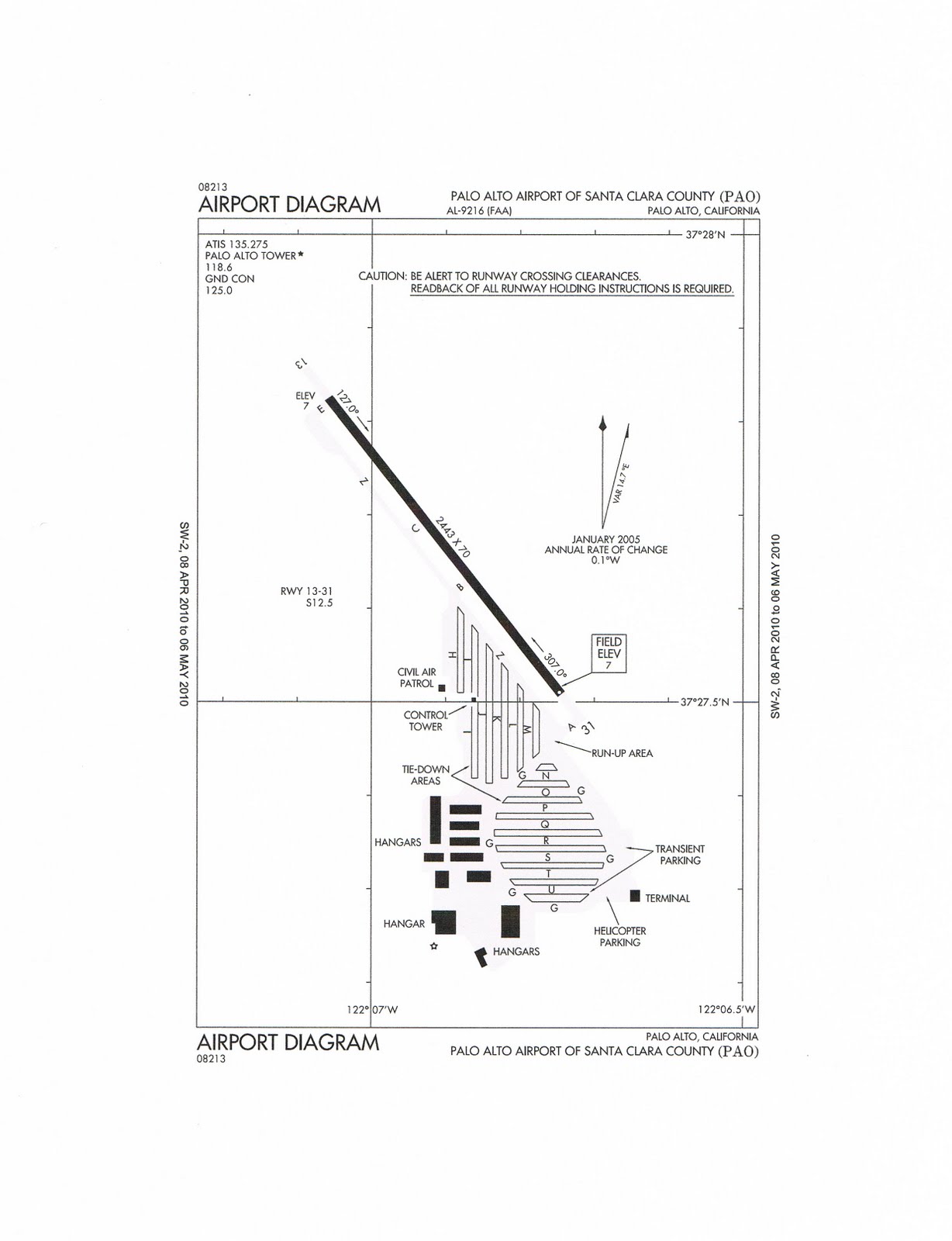
A recent accident here in the San Francisco Bay Area has me thinking about engine failures for multiengine aircraft. The accident occurred on February 17th (2010) on takeoff from Palo Alto airport. All three occupants were killed, all senior executives of the high performance electric powered Tesla sports car company, enroute to a company facility in southern California. The aircraft was a normally aspirated Cessna 310R, and the pilot was a very experienced general aviation pilot with a reputation for good judgment and proficiency.

The aircraft took off on runway 31 in conditions of very limited visibility—heavy fog—reached about 50 feet in altitude and, instead of continuing to climb straight ahead to 400 feet followed by a turn to 060, the standard instrument departure for this runway which puts the aircraft out over the South Bay, it drifted to the left, clipping a high voltage electrical tower with one wing, crashing, presumably completely out of control, into a nearby neighborhood. Fortunately, no one on the ground was hurt.

No one likes to second guess pilots following tragic accidents, and I won’t. I didn’t help, I’m sure, that the Palo Alto airport is only 2440 feet long; it didn’t help at all, I know, that the visibility was so restricted. Nonetheless, not just this pilot, but many pilots have operated safely out of this airport, in conditions like this, for a long time. But something went wrong this time.

The NTSB is still studying this accident and it will probably be several more months before anything official is released. But everything points to an engine failure at takeoff, followed by a failure to maintain directional control. If the pilot had been able to continue straight ahead, even if he couldn’t gain altitude, the area directly ahead was free of obstacles for several miles, versus the one mile or so to the tower and neighborhood. The problem is, maintaining directional control directly after takeoff at a very slow airspeed, with no outside visual references, is an extraordinarily hard thing to do. This wasn’t a bad pilot; this was a pilot who got caught by a worst case scenario of events.

So the accident got me thinking about engine failures in general, both in general aviation aircraft (I used to do quite a bit of multiengine instruction) and, of course, in corporate and airline equipment, V1 cut after V1 cut. Practice, and being ready—on every single takeoff—for an engine failure are key. But something that I didn’t learned until I got into jet training, that may or may not be common in general aviation training—I know I didn’t teach it in my multiengine instruction—may be helpful here.

The most common phrase you hear in multiengine training is, “Dead foot, dead engine,” and that is certainly a good rule to help in identifying the failed engine. But it assumes you already have things pretty much under control. A lot of things have to happen, and happen right, before you can get to “Dead foot, dead engine”; specifically, it doesn’t tell you which rudder pedal to push on.

I remember giving a pilot new to international operations training in MNPS—Minimum Navigational Performance Standards, the document that covers North Atlantic track operations between North America and Europe. I was, in turn, being observed by another captain and check airmen, Dan Drummond, a very experienced and capable pilot who did some of my own MNPS training when I started at ATA. Dan and I became good friends over the years, and were very respectful of each other’s ability, but Dan took his job seriously, and didn’t hesitate to critique my performance if he felt it necessary. On this particular occasion, he felt I was perhaps wasting some valuable instruction time enroute after I had decided the poor guy needed a little break from all the questions and “what ifs.” So Dan said, “Look, let’s talk about what we would do if we had an engine failure right here, right now.” So the copilot starting thinking, and wasn’t quite sure where the question was going, was it about identifying and shutting down an engine enroute, or notifying ATC on HF, or other aircraft in the vicinity on VHF air-to-air, or is this about drift down altitudes and diversions off the tracks, he just didn’t know where to start, and understandably: if that were to happen, it is a little hard to know what to do first, which is why Dan was posing the question. After several tries, a little mixed up, Dan asked me, and I don’t remember exactly what I said, but something like, “Well, the first priority is aircraft control, then a turn off track and a declaration of emergency to other aircraft on the track, then the engine failure checklist.” Dan said, “Right, but what does aircraft control mean? It’s on the autopilot. It’s under control isn’t it?” I said, “Of sorts, but the autopilot has no rudder control at cruise, so it’s going to try to do it all with aileron.” And Dan said, “Exactly. So the first thing we’re going to do, the very first thing, is we are going to put some rudder in.”

And that is the case in every engine failure involving multiengine aircraft (except for centerline thrust aircraft like the Cessna Skymaster), regardless of phase of flight or flight conditions. The problem is, when an engine fails, the aircraft doesn't just yaw, it also rolls. The natural reaction, ingrained from day one of flight training, straight and level flight, is to correct the roll with aileron, just like the autopilot would. And that reaction is going to happen every single time, there is just no way to avoid it. Then the second reaction is going to be, “No, not aileron, I need rudder.” But which one? I sure don’t want to make the situation worse and push on wrong rudder. Again, how do we get to “Dead foot, dead engine”?

The long way to figure it out is to think it through: I have lost an engine, I don’t know which one yet, but the aircraft wants to roll to the right and I am countering that by rolling left; what I really want is not a roll to the left but a yaw to the left: left rudder. What’s the short way to know which rudder to step? Remember a very simple rule: “Step on the low side.” (The low side of the control yoke, that is.) The aircraft wants to roll right. You counter by rolling left. That puts the control yoke down to the left. “Step on the low side” tells you to use left rudder instead.

What happens when you do that? The first thing that happens is that the rudder is much more powerful in controlling the yaw caused by the operating engine than the aileron is. In fact, even at a very slow airspeed and at full power on one side and wind milling on the other, the rudder is powerful enough to control the yaw completely, resulting in straight flight (as slow as VMC, minimum control speed). Which means the aileron is no longer needed and the aircraft will now roll into the operating engine. Instinctively you take the aileron input out to return to level flight, and when the control yoke is back to level, there will no longer be a low side, and you will know that you have the correct amount of rudder for those conditions—for that airspeed and that amount of asymmetrical power. Not enough rudder, one side will still be low, step on it a little more to get the yoke level. Too much, and the other side will be low, meaning, step on that side. (Actually, it means letting up a little on the rudder you are pushing, but since the two are connected that is the same as pushing on the low side.) The secret is to keep the yoke level, and the trick to doing that is to apply rudder to the side that is low. (Actually, up to five degrees of bank into the operating engine is allowed on check rides, and a little bit of bank is beneficial. But only a little bit—anything beyond five degrees adds drag.)

The only tricky part here is equating releasing pressure on the high side as being the same as adding pressure—stepping on it—on the low side. Going through a typical engine out scenario may help explain and clarify that. Any engine out scenario will do, the procedure is always the same, but let’s take the typical training scenario, an engine failure after takeoff. You have done everything right so far, acting instinctively to counter the roll, you saw which side of the control yoke was low, you “stepped on that side,” on that rudder, taking the aileron input out as you did, until the yoke was level. You are now flying straight but are probably barely climbing, because you still have the gear extended and haven’t secured the dead engine and feathered it’s prop, so you raise the gear and (this is where “Dead foot, dead engine” comes into play), you slowly retard the throttle on the inoperative engine, the dead engine, you pull the prop control back to feather, and you pull the mixture back to cut off for that engine. As you slowly start to climb again, your focus is 100% on wings level flight and rate of climb—gaining altitude. If you had airspeed above best single engine rate of climb speed (Vyse), it has been traded off for climb. If you are below Vyse, you need to accelerate to that speed but only if you can do so without descending. In every case you are nursing the aircraft along on one engine at full power, full or nearly full rudder against the yaw and, once cleaned up and established at Vyse, you are adjusting pitch ever so slightly to maintain that speed and climb at the maximum rate achievable. And let’s say you do all that, and finally you get to a safe level off altitude where you can start to accelerate to a single engine cruise speed, perhaps even reduce the power a little from full throttle, try to sort things out and consider your return. As you slowly pitch over and accelerate, the aircraft wants to roll again: the increased airspeed makes the rudder more effective, the extra rudder effectiveness causes the aircraft to yaw which causes it to roll and you have again, instinctively, countered that with opposite aileron. The result is that as you accelerate, one side of the yoke starts to drop again. Again, step on the low side. But you aren’t actually stepping on the low side, you’re already stepping, or holding rudder, on the other side, but you are now holding too much. You need to release some of that pressure; still, if both feet are on the pedals, the foot on the low side will be the one going forward, and the one on the high side will be coming back.

The same thing happens when you reduce power. With less asymmetric power, less rudder is needed and pressure should be released. Anytime there is a change in power or airspeed, the amount of rudder required will change. But the rule is always the same: If the control yoke is not level, the foot on the low side should be going forward—“stepping on it”—and the foot on the high side should be coming back.

There is a useful corollary to this rule, and that is the “Step on the bug” rule. This rule assumes you have a heading bug on your directional gyro, and that it has been set to the desired heading, which would be runway heading on takeoff. If you think about it, what happens to the heading bug if you drift to one side or the other of that desired heading? It swings in the opposite direction. For example, if you are taking off on runway 31, and you slowly turn to the left, the compass rose will turn clockwise as you turn through 300, 290, 280, etc, taking the heading bug with it. If you are turning left and want to correct right, you want to turn to the right. Easy enough to think through right here, sitting at your desk in front of your computer, but what about right after takeoff into IMC? Look at the heading bug, then step on it: put enough rudder pressure on the side the bug is on to cause the bug to turn back to the center. When it is back in the center, on the desired heading, release enough pressure to keep it there.

I don’t know if these memory aids would have helped this pilot or not. I don’t even know for sure what went wrong. But I do hope they help you.

Monday, February 22, 2010

Lt. D


We received the picture you see here shortly after Christmas from old friends (no, they’re not old, they’re younger than I am, you know what I mean), in Massachusetts. The reason it arrived after Christmas is because they were busy buying, packing, and mailing Christmas packages to their son in Afghanistan and to each member of his platoon, most of whom are shown here, part of the 82nd Airborne Division.

There are a lot of parts to this story, which makes it a little difficult to organize, but it starts with, having flown many troops on their way to both Iraq and Afghanistan (my last flight for ATA started troops from McCord AB on their way to Afghanistan), this was the first soldier that I personally know who has been there. I flew lots of troops, and took great satisfaction in trying to give them the best experience going over possible, and, as with so many things in the military, there is a certain reassuring sameness to it all—the variety of people the Army attracts, the calm and courtesy they always showed, the ritual and traditions of the chain of command—and having grown up and been in the military myself, it was all very familiar, so I felt like I knew them, but I never actually knew any of those troops personally.

But I have known Lt D. (I will tell you later why I call him that) since he was “that high,” and while he didn’t ask my advice nor did he need it when he announced that he was going to apply to OCS and wanted to be an infantry platoon leader, he knew I completely supported that decision. And coming from the bluest of blue states, and from an academic area on top of that, that wasn’t something that he got a lot of then, where “Bush lied and people died” was taken as an undeniable truth. Lt. D not only got accepted into OCS, but got his commission (the two are not automatic—I don’t know what the attrition rate is, but the training is as tough as the Army can make it), and then went on to Ranger and Airborne training, elite training programs and the mark of a committed soldier. Having initially been assigned a staff position in Afghanistan, he pushed to have his own platoon, a much more demanding and, yes, probably also more dangerous assignment, and why did he do that? Because he wants to be a company commander, and you can’t command a company until you can prove that you can lead a platoon. He’s done well, and I am proud of what he has done, and I am also proud because I know there are many more Lt. D’s and many more platoons like this out there, and they represent all that is good about this country.

So why do I call him “Lt. D?” Partly because my guess is that is what he is often called, just as Forrest Gump called his platoon leader “Lt. Dan.” But I don’t know that. What I do know is that security is a big issue for our troops there, and their families here. I could give you his full name, and I could tell you exactly where he grew up in Massachusetts, and enemies could search the web, discover that, and threaten his family now, and him when he returns. A stretch maybe, not very likely, but why risk it? I actually had an awkward moment learning this on my last flight. I had taken my camera along with me because I wanted to take pictures on that last flight, and I took some inside the hangar at McCord where the troops were congregated prior to boarding. I knew you weren’t supposed to take any pictures anywhere on any base at any time, but I thought a couple of very discreet pictures would be okay. I took one of some special forces troops horsing around, and a few minutes later their company commander came over and very nicely asked me not to take any more pictures, “…due to the sensitive nature of our mission.” I was very embarrassed and said, “Sorry, yes of course, no more pictures.”

I just thought this was a great picture of Lt. D and his platoon, and I left it out where I saw it every time I walked by, and then it hit me, why not send a care package yourself? So the other day I called his mother to see what sort of things they wanted and where to send them, and she said they liked having basically any kind of snack or energy food that could be stuffed in pockets for long patrols, and extra socks. (It looks like cigars are a big hit, too.) So I enlisted one of my daughters, who has a Costco card, and we went to Costco and loaded up a basket with big boxes (the only kind they have there) of candy, beef jerky, energy bars, and athletic socks. (They don’t actually sell anything called “Combat Socks,” “Athletic” is as close as they come.) That package is on its way, and I have a tracking number and will let you know its progress. So far all the USPS will tell me is that it has been “Accepted.” I should hope so.

Monday, January 25, 2010

The Other Part of Flight Planning

There is probably no aspect of aviation that has been talked and written about more, and practiced less, than flight planning. I wrote a book on flight planning myself; it was the slowest selling book I ever wrote.

Most general aviation pilots flight plan by filling up the tanks, estimating airspeed and fuel flow with basic “rules of thumb”—“I figure I cruise at 130 knots and burn 10 gallons an hour”—and select an altitude based on how high they have to go to get smooth air. Departure airport is a given, destination whichever airport is closest to the final destination—what’s the point of having an airplane if you end up having to drive further than you want to?—and alternates are something they don’t think about too much because they seldom need them and if they do there are usually a bunch to choose from, all within comfortable range since they started with full tanks and don’t usually fly all that far on any one leg anyway. If the weather looks like they have to file IFR, they pick a route that they would like to get—you never know, you might get it and you sure won’t if you don’t ask, and anyway, if maybe enough people keep filing for a route that makes sense instead of the stupid routes ATC usually gives you, maybe they might someday get the message. And for most pilots most of the time, this so called “flight planning” works. Most of the time.

The problem isn’t that it isn’t really flight planning—it is flight planning of a very rough and inefficient sort. The problem is that it doesn’t tell you anything about how the flight is actually going—it just assumes that it is going well. The only back up is a bunch of fuel, but without a clear cut plan of action, that bunch of fuel can not only disappear quickly, it can lead you to all kinds of trouble, flailing about trying to figure out what to do when Plan A didn’t work.

I’m not just picking on non-professional pilots here either when I say general aviation pilots: when I flew corporate Citations and Falcons we did exactly the same thing: filled the tanks, filed for a standard airspeed and altitude, estimated range based on rules of thumb for airspeed and fuel burns, and launched. We didn’t always fill the tanks when away from base, where it cost more, but we still put plenty on: you know, the old,”… except when you’re on fire” cliché. But the airlines do it differently, and I think there is a lot to be learned from the differences, and I think it is a big factor in explaining their much lower incident and accident rate compared to general aviation.

There are really two parts to flight planning: one, flight planning, and two, planning the flight. Sounds like the same thing, but the first part pertains to the flight from takeoff to touchdown, and the second part answers the question, “What sort of flight are you planning?” Every pilot who has ever passed a private pilot written test or done a dual cross country flight knows what flight planning is: plot a true course, convert it to magnetic, adjust for winds and compass deviation, estimate true airspeed and fuel flow, establish check points, make up a flight log, etc. But they seldom think about the second part because it seems like a given: I’m going to fly from here to there; what’s there to plan?

In terms of the departure airport, there isn’t much to plan: short of taking the wings off and trucking the aircraft to another airport, the departure point is determined by the aircraft location. (But if you rent, presumably you do have some choices there, and the most suitable departure airport then becomes a factor.) But whether you file IFR or VFR, your choice of destination airport, and your alternate airport selections, are big factors in safe and reliable flight planning—the “planning the flight” part.

Let’s look at the IFR versus VFR choice first. Obviously, if you’re not instrument rated or current, you have no choice here, but let’s assume you are (and if you’re not, start working on it right now). Most instrument rated pilots only have the rating to “keep themselves out of trouble,” meaning, so they can fly in the clouds legally if they have to. It isn’t something they want to use or like to use, it’s there just in case they need it, but the fun part is flying VFR.

The problem with that is that the only way to stay proficient in instrument techniques is to file an IFR flight plan and fly IFR all the time, regardless of conditions. If you always fly on an IFR flight plan, it will become second nature to sometimes fly in the clouds and sometimes not, to sometimes shoot a full instrument approach and other times do a visual approach. But if you only have the rating for the times you have to use it, how comfortable are you going to be in those clouds or on instruments on approach when it isn’t something you normally do? The simple truth is, if you aren’t comfortable filing IFR on VFR days, how comfortable are you going to be filing IFR on IFR days?

I know all the arguments for not filing IFR and none of them hold any water—they’re just excuses, really. But I’m not going to try to argue you out of not filing IFR all the time, because if you don’t want to hear it you won’t hear it. Just remember what I said and think about it.

So let’s assume you have decided to file IFR. The next question is, from where to where? Departure is normally a given, but the destination is not—there are almost always a variety of destination airports to chose from in the vicinity of your final destination. Some will be closer, some will have cheaper gas, some will have full service FBOs, some will have multiple runways, some may have long runways, some will have only non-precision approaches and some may have precision approaches, either ILS or LPV (localizer performance with vertical guidance, which requires approved GPS or DME/DME equipment), and a few may even have precision approach guidance to multiple runways. So how do you chose? Easy, chose the best one. If you’re talking about making your flights simple, easy, reliable, uneventful and routine, you go to the airport that has the most of everything: the longest runways, at least one precision approach to standard minimums (200 & 1/2), a full service FBO, operating control tower during the expected time of arrival, approach and departure control, the full works. I know the folks at the local grass roots airports can be very friendly and helpful and need the business, I know I don’t have to have a long runway, I know that most of the time the weather will let me get in with a non-precision approach or maybe even a contact approach, and I know I would really prefer to be as close to my final destination as I can get, but what I also know is that, when I take off, I want to have everything going in my favor to complete the flight safely and routinely.

Why not file to the close-in airport, the one without long runways and precision approaches, take a look, and if it doesn’t look good, then go to the big one? Sounds reasonable, but it isn’t just about whether the weather cooperates and lets you sneak in, it’s also about all the other little “surprises” the less than fully capable airports have in store: obstructions, narrow runways with soft shoulders, non-standard patterns, minimal lighting, poor taxiways. (As a young Part 135 pilot I once took a Cherokee 6 down a road I thought was a taxiway, tried to get back to the taxiway by cutting across the grass and dinged the prop when the nose wheel went into a ditch. The boss let me drive the prop to the prop shop for repair, on my time, as part of my “education”.) Even if you’re very familiar with the airport and don’t expect to be taken by surprise, why take any unnecessary risks when you have another nearby airport with a nice big long wide runway with a full approach light system and an ILS that will take you right down to within ½ mile of that runway, 200 feet over the approach lights, virtually guaranteeing a safe arrival?

There’s another reason not to follow this strategy, this “take a look” approach, and that is that it is human nature to want to make it work out once you’re there, to do more than just “take a look” because you don’t want to have admit that you would have been better off to just go to the big airport in the first place, so you fudge a little bit on the MDA, or maybe you do a little bit of scud running, diving through a hole because you know once you get underneath it will be “right there”, or you go back and try the approach again because you caught a couple of glimpses of the runway as you went around and you know you have a good chance of making it the next time, or you try a different approach because, “It looked like the weather was breaking up at the other end,” and so on. Those are just not safe, routine arrivals.

So you filed IFR to the best airport in the area, you shot an ILS approach to minimums, a good approach, but the “runway or runway environment” just wasn’t there, or there were thunderstorms in the vicinity, or freezing rain, or snow flurries, or a truck hit a regional jet and closed the main runway, or for whatever reason you weren’t able to land at your preferred destination. Now what?

You aren’t always required to have an alternate; if weather reports and forecasts indicate that, “For at least 1 hour before and for 1 hour after the estimated time of arrival, the ceiling will be at least 2,000 feet above the airport elevation and the visibility will be at least 3 statute miles” [FAR 91.167], an alternate is not required. What’s the significance of this? Fuel. An alternate airport requirement means you have to have enough fuel to fly from your destination to the alternate airport, so more fuel is required. This is almost never a problem for general aviation aircraft because they usually have a lot more fuel capacity than is ever really needed. And anyway, who would want to take off on an IFR flight plan with only 45 minutes more fuel than needed just because the destination was forecast to be just a little bit better than basic VFR minimums (3 miles and 2000 feet)? So the question isn’t, “Do you need an alternate airport?” but, “How do you select one?”

Under Part 121, the part under which the airlines operate, a flight cannot be release unless both the Pilot in command and a certified dispatcher have agreed on the flight plan. Discussion and negotiation are allowed, but eventually you have to agree on a plan. I used to have more disagreements with dispatchers over alternate airports than any other part of the dispatch release, because fuel planning (i.e. fuel conservation) is a big part of the dispatcher’s job, and the selection of an alternate airport determined the amount of extra fuel required, a nearby alternate requiring less extra fuel, a faraway alternate more. So dispatchers, who aren’t bad people, mind you, but they have their job and I had mine, almost always look for the closest alternate, in order to save fuel. (You sometimes wouldn’t know it, but airlines are in business to make money.) But I was the one who had to actually go there if I couldn’t get in to my original destination, and I sure didn’t want to have a problem getting into the alternate as well. If it came to diverting, I wanted to be sure it was going to be a big non event, and not more of the same only now with that much less fuel.

For example, on flights from DTW to LAS, the dispatchers would almost always select LSV, Nellis Airbase, just a few miles from LAS on the north side of town, for an alternate. If the weather went down at LAS, thunderstorms for instance, then Nellis would probably also be affected. So it really wasn’t a very good alternate, but it was close, and if thunderstorms weren’t forecast it would be legal and the dispatcher didn’t have to allow for very much extra fuel. So I would call and say I wanted a more distant alternate, LAX, for instance, and they would usually agree and give me a revised release with a little more fuel, or if they gave me a hard time I’d just put the extra fuel on, knowing I could get to LAX if I had to. Another time I was going somewhere in the Caribbean, St. Martin I think, and the dispatcher gave me some little island airport I had never heard of for an alternate, it had one runway, a non-precision approach, and was listed as a Special Airport, meaning there was something unusual enough about it to require an airport briefing or prior experience, but it was nearby. I called and got quite of bit of resistance, the dispatcher telling me that it was all legal and the weather was good in St. Martin anyway and what was the problem? I said the problem is, this is the Caribbean, where anything can go wrong, single airport runways get closed because of damaged aircraft, thunderstorms roll in unexpectedly, radars go down, power fails, five aircraft arrive at once and four have to hold, all kinds of things that lead to diversions, and when that happens I don’t want to have to go to another airport with only one runway, a non-precision approach, no radar, and special approach restrictions. So I got a better alternate, probably San Juan, and no, I didn’t need it, but I sure was glad to have it and to not have to worry all the way to St. Martin about it.

Under Part 91 you don’t have to have a dispatcher sign off on your flight plans, so you can pick any alternate you want, even none at all if the destination weather is good enough. And because of that it often doesn’t get much thought, just a quick check to make sure there are some other airports with decent weather forecast nearby, the assumption being you probably won’t need it anyway and if you do you’ll deal with the weather that actually exists at that time, real reports, not forecasts, so you’re good to go. And that is absolutely not the way to do it, for all kinds of reasons, but the main one is if you are shut out at your destination for any reason—weather, runway closures, security threats, lost pilots in the vicinity—you don’t want to have to figure out what to do at that point, you want to already know what you’re going to do and then just do it. Before you left you should have said, “I’m going to fly from this airport to that airport, and if that doesn’t work out I’m going to fly to this other airport, an airport that has several runways, several approaches including an ILS, approach radar, excellent weather forecast, and I’m going to land there, and that is that. Not that it can’t be changed if needed: if you get to your destination, and can’t land, and you advise ATC that you want to go to your alternate, and they tell you it isn’t available for some reason, or it is but the ILS is out of service and the weather is marginal, or you head that way and check the weather, and the same weather that shut you out at your destination is headed that way also, of course you can ask ATC to check the conditions for you at other airports nearby and change your alternate. But changing your alternate is a lot different than not really having one in the first place, or having to pick one quickly after having just done a missed approach because a snow flurry hit the field and visibility dropped to zero.

So let me summarize how I think you should plan a flight: Choose a destination airport that is the best you can find within a practical distance from your final destination; select an even better airport for your alternate, one with excellent approach and landing facilities and good weather, one that virtually assures a safe arrival; fly to your destination; if that doesn’t work out, go to your alternate and land. That’s the easy way to plan a flight, and the best way I know to make sure your flight ends up with everyone walking away happy.

Thursday, December 17, 2009

Single Pilot Cockpit Techniques, Part III

Use your autopilot.

I give you the conclusion first, and if that’s all you need, fine, but autopilots are much misunderstood and therefore misused, and are worth some further thought.

The Basics. Autopilots are classified by axis, one, two, and three, corresponding to the three axis about which the aircraft rotates: roll, pitch and yaw. A simple, one axis autopilot, often called a wing leveler, controls the roll axis. A two axis autopilot controls roll and pitch, and in its simplest form is therefore both a wing leveler and pitch hold, with altitude hold, altitude preselect, heading hold and nav tracking being useful complements to the basic roll and pitch commands. A three axis autopilot (often erroneously used to describe a “full” autopilot with altitude hold and preselect and all nav and approach functions), is normally only found on turbine powered multiengine aircraft, and provides for engine out control by the autopilot: the third axis, yaw, provides the rudder power to maintain directional control with an engine out and varying degrees of power from the remaining engine or engines. Even with the third axis of control, it normally is only coupled when in the approach and go around modes: climb, cruise, and descent are normally uncoupled from the yaw axis and still require manual rudder input or rudder trim on the part of the pilot. (The reasons for this are very complex and have to do with autopilot certification standards, balancing autopilot functionality with negative consequences of autopilot failures, a very technical topic beyond the basics of autopilots.)

Some aircraft have yaw dampers (or dampeners), which is not an autopilot per se but does use the rudder to counter unwanted yawing, usually caused by unwanted rolling motions. Sweep winged aircraft are particularly susceptible to this uncomfortable rolling, yawing motion—the dreaded Dutch Roll—which on earlier swept wing aircraft could reach uncontrollability if left unchecked: one of the required maneuvers on the Boeing 727 type rating check ride was to regain control after the yaw dampener had been turned off and a big yaw intentionally induced. As I remember, the yaw damper was a no-go item. But a yaw damper is not part of the autopilot system and is not powerful enough to negate the adverse yaw resulting from an engine out.

Any autopilot is better than no autopilot, but the minimum for single pilot VFR flight is a single axis, or wing leveler, type autopilot (and with a heading hold or heading bug could be quite useful), while the minimum for IFR flight would be a two axis with at least heading hold and altitude hold. Each allows you to let go of the aircraft in order to do all the other things a single pilot has to do: read charts, set power, lean mixtures, write down frequencies, keep a flight log, pick up the pencil that dropped on the floor, change fuel tanks, look ahead and so on and so on. The reason I believe you need both heading hold and altitude hold for IFR is because altitude control is so much more critical on an instrument clearance than it is on a VFR flight. If the altitude nudges upward or downward a hundred feet or so VFR while looking away, you haven’t violated an assigned altitude clearance, the aircraft is still firmly under control, and a little pressure or pull on the control column will easily get it back on altitude again. But the same thing IFR is a serious enough deviation from your assigned altitude to either cause problems with ATC if left uncorrected, or take so much attention that whatever it was that you needed to do besides fly the aircraft doesn’t get done.

Pilots often feel that using the autopilot is a sign of weakness—a crutch—and if the best pilot in the airplane is the autopilot, there is some truth to that. An autopilot is no substitute for basic flying skills which, in the case of an instrument rated pilot means more than just being able to hold altitude and heading, but also being able to shoot accurate approaches to minimums. And there is no substitute for hand flying to keep those skills tuned. But assuming your basic flying skills are acceptable, and you could hand fly the airplane throughout its full profile from climb out through the approach if necessary, there is absolutely nothing wrong with using the autopilot so that you can concentrate on the rest of the job—managing the flight—without the distraction of having to constantly keep scanning and correcting. That’s what it’s there for.

A couple of examples from the world of turbine aircraft may help illustrate this. The Cessna Citation SP is certified for single pilot operation, but only if the autopilot is functional. Makes sense. And let me tell you a little secret: It is an incredibly easy airplane to fly, much simpler than a typical reciprocating general aviation twin. The straight wing is as forgiving as a Cessna Skylane, with near centerline thrust an engine out is very easy to handle, and the power couldn’t be easier to manage: one power control, push forward for more, pull back for less. The fuel is either on, off, or crossfeed. The rest of the aircraft systems can be covered in a day of ground school. And the FAA still requires a fully functioning autopilot to be flown single pilot.

MNPS (Minimum Navigational Performance Specification), the document that describes equipment and procedures necessary to fly from FL 290 to FL 410 over the North Atlantic, one of the most heavily trafficked, non-radar controlled airspaces in the world, specifies that an autopilot be used at all times when in that airspace. Aircraft separation along these tracks is predicated on accurate tracking of course and very accurate maintenance of altitude, and it simply won’t allow for a pilot’s momentary lack of concentration. Anytime you’re in congested airspace, you would be wise to do the same.

At ATA Airlines, we trained to hand fly approaches to below standard minimums, and were required to demonstrate, on our check rides, the ability to hand fly an engine out approach to minimums and then do a go around. But in line flying it was ATA’s policy to do all approaches to minimums on the autopilot, and to do all Cat II (below standard minimums) and Cat III approaches (no minimums) using not just one but all autopilots, which in the case of the Boeing 757 meant all three autopilots (two for the Lockheed 1011). The reason for that was mostly redundancy—if one failed at normal minimums the approach could be continued to an autoland on the remaining autopilot or autopilots—but also accuracy: each autopilot monitored the other both for deviations from standard and for increased accuracy. If airline pilots have to use three autopilots in certain circumstances, I wouldn’t feel too bad using one. Again, that’s what it’s there for.

So train by hand flying and practice by hand flying when conditions allow, but the rest of the time, use your autopilot. It’s one of the best ways to make your job easier, your results better and, all things considered, be a better pilot.