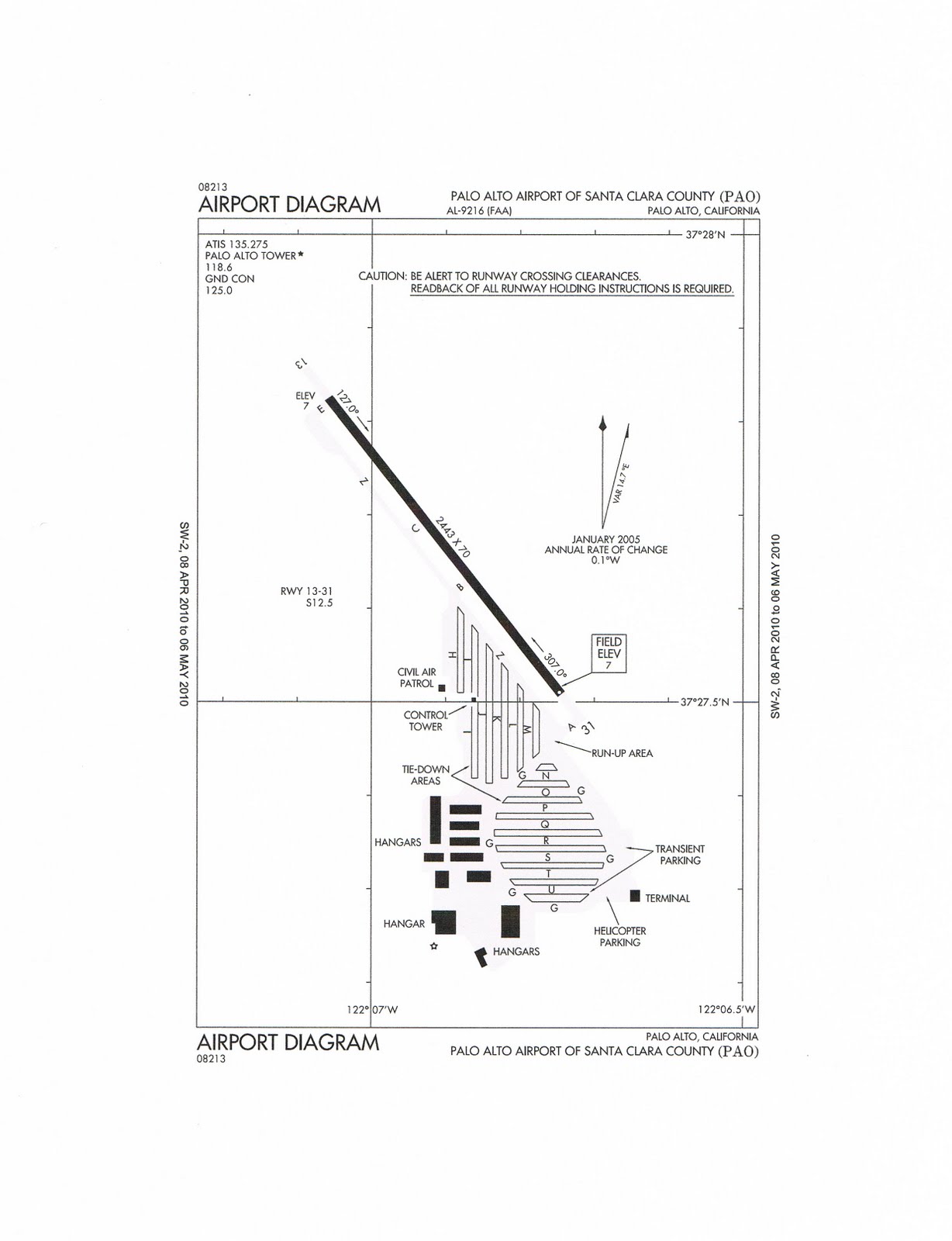
A recent accident here in the San Francisco Bay Area has me thinking about engine failures for multiengine aircraft. The accident occurred on February 17th (2010) on takeoff from Palo Alto airport. All three occupants were killed, all senior executives of the high performance electric powered Tesla sports car company, enroute to a company facility in southern California. The aircraft was a normally aspirated Cessna 310R, and the pilot was a very experienced general aviation pilot with a reputation for good judgment and proficiency.
The aircraft took off on runway 31 in conditions of very limited visibility—heavy fog—reached about 50 feet in altitude and, instead of continuing to climb straight ahead to 400 feet followed by a turn to 060, the standard instrument departure for this runway which puts the aircraft out over the South Bay, it drifted to the left, clipping a high voltage electrical tower with one wing, crashing, presumably completely out of control, into a nearby neighborhood. Fortunately, no one on the ground was hurt.
No one likes to second guess pilots following tragic accidents, and I won’t. I didn’t help, I’m sure, that the Palo Alto airport is only 2440 feet long; it didn’t help at all, I know, that the visibility was so restricted. Nonetheless, not just this pilot, but many pilots have operated safely out of this airport, in conditions like this, for a long time. But something went wrong this time.
The NTSB is still studying this accident and it will probably be several more months before anything official is released. But everything points to an engine failure at takeoff, followed by a failure to maintain directional control. If the pilot had been able to continue straight ahead, even if he couldn’t gain altitude, the area directly ahead was free of obstacles for several miles, versus the one mile or so to the tower and neighborhood. The problem is, maintaining directional control directly after takeoff at a very slow airspeed, with no outside visual references, is an extraordinarily hard thing to do. This wasn’t a bad pilot; this was a pilot who got caught by a worst case scenario of events.
So the accident got me thinking about engine failures in general, both in general aviation aircraft (I used to do quite a bit of multiengine instruction) and, of course, in corporate and airline equipment, V1 cut after V1 cut. Practice, and being ready—on every single takeoff—for an engine failure are key. But something that I didn’t learned until I got into jet training, that may or may not be common in general aviation training—I know I didn’t teach it in my multiengine instruction—may be helpful here.
The most common phrase you hear in multiengine training is, “Dead foot, dead engine,” and that is certainly a good rule to help in identifying the failed engine. But it assumes you already have things pretty much under control. A lot of things have to happen, and happen right, before you can get to “Dead foot, dead engine”; specifically, it doesn’t tell you which rudder pedal to push on.
I remember giving a pilot new to international operations training in MNPS—Minimum Navigational Performance Standards, the document that covers North Atlantic track operations between North America and Europe. I was, in turn, being observed by another captain and check airmen, Dan Drummond, a very experienced and capable pilot who did some of my own MNPS training when I started at ATA. Dan and I became good friends over the years, and were very respectful of each other’s ability, but Dan took his job seriously, and didn’t hesitate to critique my performance if he felt it necessary. On this particular occasion, he felt I was perhaps wasting some valuable instruction time enroute after I had decided the poor guy needed a little break from all the questions and “what ifs.” So Dan said, “Look, let’s talk about what we would do if we had an engine failure right here, right now.” So the copilot starting thinking, and wasn’t quite sure where the question was going, was it about identifying and shutting down an engine enroute, or notifying ATC on HF, or other aircraft in the vicinity on VHF air-to-air, or is this about drift down altitudes and diversions off the tracks, he just didn’t know where to start, and understandably: if that were to happen, it is a little hard to know what to do first, which is why Dan was posing the question. After several tries, a little mixed up, Dan asked me, and I don’t remember exactly what I said, but something like, “Well, the first priority is aircraft control, then a turn off track and a declaration of emergency to other aircraft on the track, then the engine failure checklist.” Dan said, “Right, but what does aircraft control mean? It’s on the autopilot. It’s under control isn’t it?” I said, “Of sorts, but the autopilot has no rudder control at cruise, so it’s going to try to do it all with aileron.” And Dan said, “Exactly. So the first thing we’re going to do, the very first thing, is we are going to put some rudder in.”
And that is the case in every engine failure involving multiengine aircraft (except for centerline thrust aircraft like the Cessna Skymaster), regardless of phase of flight or flight conditions. The problem is, when an engine fails, the aircraft doesn't just yaw, it also rolls. The natural reaction, ingrained from day one of flight training, straight and level flight, is to correct the roll with aileron, just like the autopilot would. And that reaction is going to happen every single time, there is just no way to avoid it. Then the second reaction is going to be, “No, not aileron, I need rudder.” But which one? I sure don’t want to make the situation worse and push on wrong rudder. Again, how do we get to “Dead foot, dead engine”?
The long way to figure it out is to think it through: I have lost an engine, I don’t know which one yet, but the aircraft wants to roll to the right and I am countering that by rolling left; what I really want is not a roll to the left but a yaw to the left: left rudder. What’s the short way to know which rudder to step? Remember a very simple rule: “Step on the low side.” (The low side of the control yoke, that is.) The aircraft wants to roll right. You counter by rolling left. That puts the control yoke down to the left. “Step on the low side” tells you to use left rudder instead.
What happens when you do that? The first thing that happens is that the rudder is much more powerful in controlling the yaw caused by the operating engine than the aileron is. In fact, even at a very slow airspeed and at full power on one side and wind milling on the other, the rudder is powerful enough to control the yaw completely, resulting in straight flight (as slow as VMC, minimum control speed). Which means the aileron is no longer needed and the aircraft will now roll into the operating engine. Instinctively you take the aileron input out to return to level flight, and when the control yoke is back to level, there will no longer be a low side, and you will know that you have the correct amount of rudder for those conditions—for that airspeed and that amount of asymmetrical power. Not enough rudder, one side will still be low, step on it a little more to get the yoke level. Too much, and the other side will be low, meaning, step on that side. (Actually, it means letting up a little on the rudder you are pushing, but since the two are connected that is the same as pushing on the low side.) The secret is to keep the yoke level, and the trick to doing that is to apply rudder to the side that is low. (Actually, up to five degrees of bank into the operating engine is allowed on check rides, and a little bit of bank is beneficial. But only a little bit—anything beyond five degrees adds drag.)
The only tricky part here is equating releasing pressure on the high side as being the same as adding pressure—stepping on it—on the low side. Going through a typical engine out scenario may help explain and clarify that. Any engine out scenario will do, the procedure is always the same, but let’s take the typical training scenario, an engine failure after takeoff. You have done everything right so far, acting instinctively to counter the roll, you saw which side of the control yoke was low, you “stepped on that side,” on that rudder, taking the aileron input out as you did, until the yoke was level. You are now flying straight but are probably barely climbing, because you still have the gear extended and haven’t secured the dead engine and feathered it’s prop, so you raise the gear and (this is where “Dead foot, dead engine” comes into play), you slowly retard the throttle on the inoperative engine, the dead engine, you pull the prop control back to feather, and you pull the mixture back to cut off for that engine. As you slowly start to climb again, your focus is 100% on wings level flight and rate of climb—gaining altitude. If you had airspeed above best single engine rate of climb speed (Vyse), it has been traded off for climb. If you are below Vyse, you need to accelerate to that speed but only if you can do so without descending. In every case you are nursing the aircraft along on one engine at full power, full or nearly full rudder against the yaw and, once cleaned up and established at Vyse, you are adjusting pitch ever so slightly to maintain that speed and climb at the maximum rate achievable. And let’s say you do all that, and finally you get to a safe level off altitude where you can start to accelerate to a single engine cruise speed, perhaps even reduce the power a little from full throttle, try to sort things out and consider your return. As you slowly pitch over and accelerate, the aircraft wants to roll again: the increased airspeed makes the rudder more effective, the extra rudder effectiveness causes the aircraft to yaw which causes it to roll and you have again, instinctively, countered that with opposite aileron. The result is that as you accelerate, one side of the yoke starts to drop again. Again, step on the low side. But you aren’t actually stepping on the low side, you’re already stepping, or holding rudder, on the other side, but you are now holding too much. You need to release some of that pressure; still, if both feet are on the pedals, the foot on the low side will be the one going forward, and the one on the high side will be coming back.
The same thing happens when you reduce power. With less asymmetric power, less rudder is needed and pressure should be released. Anytime there is a change in power or airspeed, the amount of rudder required will change. But the rule is always the same: If the control yoke is not level, the foot on the low side should be going forward—“stepping on it”—and the foot on the high side should be coming back.
There is a useful corollary to this rule, and that is the “Step on the bug” rule. This rule assumes you have a heading bug on your directional gyro, and that it has been set to the desired heading, which would be runway heading on takeoff. If you think about it, what happens to the heading bug if you drift to one side or the other of that desired heading? It swings in the opposite direction. For example, if you are taking off on runway 31, and you slowly turn to the left, the compass rose will turn clockwise as you turn through 300, 290, 280, etc, taking the heading bug with it. If you are turning left and want to correct right, you want to turn to the right. Easy enough to think through right here, sitting at your desk in front of your computer, but what about right after takeoff into IMC? Look at the heading bug, then step on it: put enough rudder pressure on the side the bug is on to cause the bug to turn back to the center. When it is back in the center, on the desired heading, release enough pressure to keep it there.
I don’t know if these memory aids would have helped this pilot or not. I don’t even know for sure what went wrong. But I do hope they help you.