Wednesday, July 30, 2008

Oshkosh, Tuesday


Tuesday was another great day, but hotter and stickier (but with a cold front forecast). My talk (Air Navigation, Past, Present, Future) went well, although it wasn't as well attended as last year. But then again, everything seems to be a little bit down from last year--aircraft, visitors, campers--I assume due to the high cost of gasoline. Still, the slide show worked, no one walked out, and I was pleased with how it went.

The Author's Corner that followed was less exciting. Author's Corner is essentially a section set aside in several of the different sales venues for authors to sit and meet people interested in their book, sign copies, and make some sales. I was assigned the 400pm to 515 pm slot on a hot afternoon with an airshow going on. I got exactly zero visitors unless you want to count the one guy who thought I was an employee and wanted to know if we had a certain book he was looking for (not mine). I have two more times assigned this week, better times, I hope on cooler days, and I hope with better results.

My wife and I have walked many miles looking at aircraft of all sorts. The photo above is my favorite so far, a perfectly restored Twin Beech, circa 1946, an important year for me as well as this aircraft.

Monday, July 28, 2008

Oshkosh, Monday

Oshkosh opened on a perfect day, sunny, good visibility, temperature in the low '80's with dry air and a nice breeze out of the northeast. It still got hot, but then again, it is summer.

This is a huge event for this area, of course, and while everyone knows about it out here, they don't call it "Oshkosh," because Oshkosh is where they live. They call it "EAA," which they know is the huge organization behind it. The EAA calls it "AirVenture 2008." I kind of like "Oshkosh," because that is what everyone in aviation calls it, you just can't do that here or they look at you with a funny look that says something like, "What do you mean "You're here for Oshkosh?" You're in Oshkosh!"

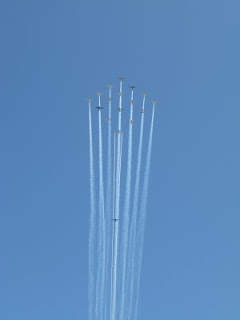
Opening day traditionally begins with the arrival of several fleets of "warbirds"--restored military trainers and fighters. The photo above was typical of their arrival.

Friday, July 18, 2008

Prelude to Oshkosh

I’ve been taking a break from posts for awhile for several reasons, but probably the main reason is that the last two posts, “The Test” and “The Way”, represented fairly major efforts and I sort of wanted to sit on them for awhile before I did anything new. Also, “Oshkosh” (more properly, “AirVenture 2008”), is coming up in just over a week, and I want to wait for that to begin anything substantial. My talk is ready, with, I hope, foolproof illustrations on a Picasa Gift disk, which I learned includes the Picasa software so it can be used on any computer. (Picasa is a free download from Google and works great.) I will also be promoting my navigation book at the Author’s Corner on three separate occasions. If you’re there, I hope you will come by; I will happy to personalize and sign any purchase. (Part of the proceeds go to EAA, a non-profit organization, so you will be helping them as well as me, a little bit more of a feel good sort of thing than a regular bookstore purchase.) My wife and daughters will be there along with one of my oldest friends, Rusty Sachs, a Marine Corp Viet Nam vet chopper jock with a Purple Heart to show for it. Rusty retired recently as the head of NAFI (National Association of Flight Instructors), a component of EAA. It should be a fabulous week and I hope to make regular posts with photos. (Last year's event provided many of the photos used on previous posts, including this one).

For more information on the event, including daily schedules (every afternoon features an air show, for instance), go to www.airventure.org.

Saturday, June 14, 2008

The Way

The question is this: Can we say, in just a few words, what it is that makes a good pilot? A quick review.

First, we know it isn’t luck. Luck—the random, the chaotic, the unpredictable—is always there, in aviation as in anything, but for good pilots randomness is just part of the fun, part of what makes it interesting. Good luck has nothing to do with what it takes to be a good pilot, and bad luck has nothing to do with being a not-so-good pilot. It’s not luck. (See “Are you feeling lucky, punk?”)

Second, what, more than anything else, distinguishes a good pilot from a not-so-good pilot? Simple: The good ones make it look easy; the not-so-good ones make it look hard. (See “The Test.”)

So the question boils down to this: How do the good ones make it look easy? And I think the key to answering that question lies not in how the good ones make it look easy, but in how the not-so-good ones make it look hard: It’s easy to make it look hard, just act real busy all the time without actually doing anything. But it’s very hard to make it look easy. And there’s the rub: The hard way is the easy way. Let me try to explain what I mean.

Mark Barnard was a very good friend of mine at ATA. I first met him when he taught my navigation class and later, when I upgraded to 727 Captain, he taught general operations, otherwise known as “Charm School.” (“Charm School” is where an experienced Captain tries to tell new Captains how to stay out of trouble.) He impressed me both times not just with his knowledge, but also with his wit and intelligence. He eventually went on to be the Chief Pilot for the L-1011, a position that suited him perfectly because he loved the 1011, was on a first name basis with most of the 1011 engineers at Lockheed, and was probably the most knowledgeable person outside of Lockheed on that airplane. He and I, along with another friend and Check Airman, John Stahl, were in Indianapolis working on a major revision to the L-1011 operations manual on September 11, 2001. I ended up doing a rescue mission when flying resumed, but in street clothes because I hadn’t taken a uniform. No one seemed to mind. We never finished the revision. So we have a little history.

Mark used to say that his father, an Indiana farmer with little education, was one of the smartest people he ever knew. He quoted his father a lot, and one of his better sayings was, “If you don’t have time to do it right, you sure don’t have time to do it wrong.” It was funny and smart at the same time, which made it easy to remember. It was also another way of saying, “The hard way is the easy way.”

This wasn’t a lesson that came to me naturally. I’m not very good with tools. I don’t know why. My father is, my brother Dean was, but I’m not. A lot has to do with my impatience and some has to do with laziness. (An FAA inspector once told me that the goal of all pilots was to have the most amount of fun with the least amount of effort. Not too far from the truth, actually.) I’m much more likely to reach in the kitchen drawer and grab a table knife to tighten the screw on the pot handle than I am to go to the basement where I keep my tools and get a screwdriver. And I’ll do this knowing that the best that can come out of it is that the pot handle will still have to be retightened a week later, and the worst that can come out of it is that I will ruin the knife, wreck the slot in the screw, and have to either throw the pot out or spend some money getting somebody who knows what he’s doing to fix it. The hard way to fix it, for me, is to take the time to go get the screwdriver—the right one, the one that fits, even if that means going back to the toolbox again—and do it right the first time, because that seems to take extra effort. But the hard way ends up being the easy way.

How does this apply to aviation, to being a good pilot? The answer is probably not the one anyone wants to hear, but here it is anyway: There is no easy way to be a good pilot. No one is born a pilot. It has to be learned, and no one learns anything without an effort, and no one retains the skills and knowledge without practice and review. Flight planning and preflights, weather briefings and weight and balance do not happen by themselves. There are no short cuts, no easy ways, “Nothing will come of nothing.” (King Lear, Act I, Scene 1.) The good ones make it look easy because they have worked hard to be good pilots. They are never content to reach a certain minimally acceptable level and then quit. The good ones read, they think, they never have aviation too far from their minds. As a practical matter, they know that being a good pilot takes time—both time to learn and time to do it right.

This means they don’t just check the destination weather and forecast; they get a full briefing. This means they don’t just open the hangar doors, drag the airplane out and fly away; they do a complete preflight including powering up the panel and checking the flight instruments and aircraft systems. It means, if they are VFR-only pilots, that they don’t just stick a Garmin on the panel and launch, hoping for the best; they prepare a dead reckoning log with VOR cross checks to back up their GPS. If they are instrument-rated, they file IFR for every serious cross country—anytime the object is to get somewhere, as opposed to just flying around to have fun—because they know that is the sound and sensible way to do it and the best way to stay current and confidant in their instrument skills. They also prepare a flight log and keep a running tally of times and fuel enroute, and when the trend is negative they have a Plan B. It means they sometimes file to destinations that are further away from where they want to go, but that have good approach facilities and long runways. It also means that when they do try to fly to small airports with limited approaches and facilities, they don’t keep trying when the first attempt doesn’t work; they divert to their alternate, an alternate that does have good approaches, good facilities, and much better weather forecast. They land, and that’s that—no drama, no scares, no worries.

In means, in short, that good pilots do what they have been trained and taught to do, not what is easy to do. I can’t list everything a good pilot should do—that’s what flight training is for. I can only tell you that that is what you must do if you want to make it look easy. Good flying should be boring—the exciting part is having a flight go off smoothly and without a hitch, even if you’re the only one who knows how much work it took. The hard way is the easy way. All the rest is just, “a tale told by an idiot, full of sound and fury, signifying nothing.” (Macbeth, Act V, Scene 5.)

Edited by Nicole Clausing

Wednesday, May 14, 2008

The Test

Back in the early ’70s, shortly after I was released from active duty as a tank platoon leader, I found myself in a graduate-level course in English at the University of Michigan. (In cockpit conversations, stories like this usually begin with, “In a previous life….”) How that happened, and why, and where it went from there, is not terribly important. What is important is something I learned in that course, something that had very little to do with the study of English per se, but an awful lot to do with life in general.

The course itself was a comparison of the works of Henry James and Mark Twain, two 19th century authors about as far apart as the Army was from graduate school. Both were master story tellers, but where Twain’s stories were full of action on the surface but with much more complex and even sinister currents underneath, James’s were enormously subtle, even, at times, tedious, on the surface, but with powerful, slow moving currents underneath. Twain was far easier and more enjoyable to read, to me anyway, and to most of the other students in the class, while James was a bit of a struggle—his slow-paced, somewhat archaic character studies didn’t appeal to our need for action and drama.

The professor knew this—I’m sure he dealt with it each time he taught the course—and he was ready with a defense of James. He asked the question, “How do you know when someone is really good at something—better than almost anyone else? Not just good at writing novels, but anything: baseball, music, art, acting, raising kids—anything.” That was quite a question. I don’t know what we said; whatever it was we clearly didn’t have the time to come up with a well thought-out answer, so he answered it for us.

“I think,” he said, “We know when someone has done something exceptionally well when he, or she, makes it look easy. The outfielder, for instance, who always seems to be standing right where the ball is hit makes it look easy. The outfielder who needs to make a spectacular diving run to catch the ball makes it look like he is good, and he is to an extent, but the better player is the one who was standing there already. And the same applies to writers, Henry James, in this case. It seems like nothing actually happens in his stories, but in fact we are mislead because he makes something that is actually very difficult, a story that centers on character, not action, seem so easy. We are tempted, with James, to think that nothing is going on, just as we are tempted to think that the outfielder who is always in position is just lucky. But, in fact, both are actually making something very difficult look easy, and they are able to do that because both are so good at what they do.”

That class was a long time ago, so I’m not quoting his exact words, but that is more or less what I remember, and I remember it well because it was, I thought, a tremendously significant insight. It applies, of course, to aviation as well: The good ones make it look easy, the not-so-good ones make it look hard. The good pilots always seem to have easy, even boring flights; up and down, the same old thing every day. Once in awhile a curve ball gets thrown, a long line of thunderstorms has to be circumvented, an aircraft system malfunctions, a medical emergency occurs, but the good ones seem to just take care of the problem and move on. The not-so-good ones bark orders, change their minds, focus on a small part of the problem and let the big part get worse and often compound the problem before finally solving it. Their flights are seldom uneventful and are usually full of drama. Ironically, often they, and sometimes others, think that they are the good ones, taking charge, making decisions, barking orders, and that the ones who make it look easy are just lucky or lazy.

There are, of course, times when every pilot needs to get busy, take charge, and, if not bark, at least issue some orders. Making it look easy is not the same as doing nothing, and making it look hard doesn’t mean it isn’t actually sometimes hard. Just as it’s sometimes difficult to distinguish between a sales pitch and good information, it is sometimes difficult to distinguish between making it look easy and being easy, and making it look hard and being hard. But it usually doesn’t take very long to figure it out. The lazy pilot will get in trouble at some point—his, or her unwillingness to do what is required will eventually result in a small problem becoming a bigger problem. And the pilot who lacks the ability or the willingness to make the solution look easy will always make it look hard, even when it isn’t. Sometimes, he or she may even want to make it look hard to show to fellow crewmembers what a terrific pilot he or she is, afraid that no one will notice otherwise.

So what I learned in that English course almost forty years ago stuck with me and has formed the basis for what I call The Test: Are you making it look easy, or are you making it look hard? If you’re not making it look easy, as easy as it can be anyway, then you’re on the wrong path.

The Test itself is simple—a question you can ask yourself to see how you are doing. Getting on the right path is the hard part, and that will be the subject I will take up in the next post, to be called The Way.

Edited by Nicole Clausing