Sunday, March 27, 2011

Quick Reference Handbook


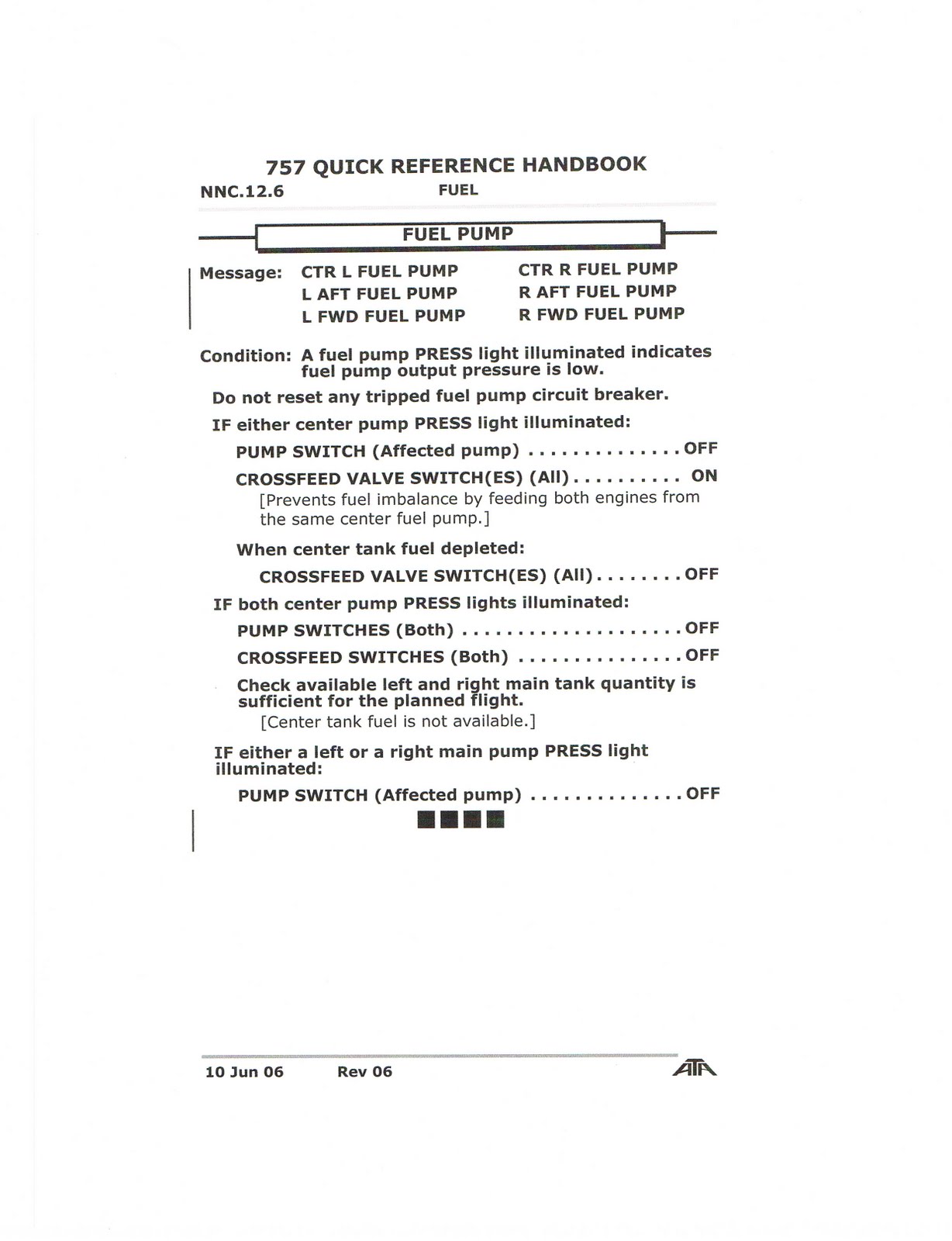
(Double click on image to enlarge.)

I have written previously about adapting professional lessons in cockpit management to single pilot operations (October 2009, November 2009 and December 2009 posts), and this is a specific application of those techniques: creating a quick reference handbook.

One of the main differences between a three man cockpit (okay, three crewmember cockpit) and a two man cockpit is that with a three man cockpit you can designate one pilot to fly the aircraft, while the other two work on the problem. With two crewmembers to work on the problem, one can do the research—get out the aircraft operating manual, go through the various problem solving trees to identify the specific problem, and then, with the help of the non-flying pilot, run the appropriate checklist and attempt to solve the problem. (I review this process in some detail in the October 2009 post, “Single Pilot Cockpit Techniques, Part I.”)

With only two crewmembers, you just can’t do this. You are either going to have one pilot doing the research and running the checklist by himself, with no one to monitor and assist him, or worse, you’re going to have both pilots working on the problem and no one watching the airplane. But the airlines knew problems will occur with any airplane and that they have to be fixed, so a solution was needed and the result was the creation of something called a Quick Reference Handbook (QRH). So what’s the difference between a QRH and just using common sense, training and aircraft knowledge to solve the problem from memory, and how can a QRH be applied to single pilot operations, where one pilot has to both fly and solve the problem?

A QRH is essentially a problem solving checklist associated with a specific indication. That indication could be an annunciator light, a message on a multi function display (MFD), or a warning light. It could even be something not specifically annunciated, but indicated, such as electrical smoke or fumes. In each case, something specific has happened and the QRH, following a prescribed format, will note the indication (to make sure you have the right checklist), briefly describe what has happened (you would have to get into the operating manual for a detailed description), repeat any memory items to make sure they got done, and then tell you what to do often following an “if, then” format, the “if not” choice leading to the next step.

The example above comes from the ATA Boeing 757 QRH for failure of one or more fuel pumps. The annunciation in this case is a message on the MFD for the specific pump that has failed. If that isn’t the correct message, you have the wrong checklist. The condition describes what has happened. (It’s obvious in this case, but won’t always be.) Under that is a warning, taken directly from the Boeing operating manual, not to reset any fuel pump circuit breakers: you can manage the loss of a single pump, but you do not want to take a chance that the breaker popped because of a feeder fault—an ignition source. Then it says, “IF either center pump PRESS light illuminated”, turn it off: you look overhead to the pump switches, if either has a PRESS light illuminated, a part of the switch, push it which turns it off. Very simple. If not, neither center pump press light illuminated, go to the next step. (Note that if both center pump switches are illuminated, now you have a bigger problem because you have no way to pump the fuel from the center tank which is essentially an aux tank for the 757.) If that is not the case, then one of the wing pump press lights must be on—something triggered the message—so identify which one, turn it off and proceed. (As a matter of interest, there isn’t a warning for both main pump press lights being on because the engines will suction feed from the wing tanks, so you just turn them both off it that is the case. But if I had written this QRH entry, I would have made a note of that.)

So that’s how a QRH checklist works. It is designed to be as simple and direct as possible so that one crewmember can find it, read it, and then accomplish it without backup, assistance, or verification. And the same thing can be developed for whatever aircraft you fly. Your “pilot flying” will have to be the autopilot, leaving you free to find and accomplish the checklist, but the principle is the same. (I’m assuming you are flying IFR; VFR is a little more tolerant and you should be able to hand fly and consult the QRH at the same time if you don’t have an autopilot.) It will take a little work to create a complete QRH, but it will be worth it, if for no other reason than that it will get you back into your operating manual in some detail.

First you need to identify the annunciations for your aircraft. Do you have an annunciator panel? If you do, each light should have a corresponding QRH checklist. What other warning lights do you have? Low oil pressure, vacuum failure, generator/alternator failure? Finally, what are the non-annunciated failures? Most of these you will get by going through your operating manual, particularly the emergency section, and listing problems that have no annunciation, like the electrical smoke or fumes previously cited, engine failure, gauges out of limits with no other indication, and so on.

Once you have your list, you are ready to make up your QRH responses. Remember to start with the annunciation, indication or condition, to make sure you have the right checklist. State in as simple a sentence as you can what it means: “Engine driven pump failure”; “Vacuum pump failure”; “Gear not confirmed down and locked,” etc. If there are any prohibitions or warnings, they should come next, not at the end when it may be too late: “Gear must remain extended after manual extension. Do not reset any handles, switches or circuit breakers.” Then go through a step by step procedure, using an “if, then” format as necessary, to solve the problem.

Here’s how one might look for a Beech Baron 58P vacuum pump failure:

VACUUM PUMP FAILURE

Indication: A left or right red button in vacuum pressure gauge indicates pump failure.

Condition: Left or right vacuum pump has failed.

IF one button visible:

No action required. Attitude and heading gyros, pressurization, and deice boots will operate normally on remaining system. Vacuum system redundancy lost: Monitor remaining system.

IF both buttons visible:

Attitude and directional gyros lost. Control attitude and heading with turn coordinator, airspeed, altitude and compass.

Pressurization control and safety valve control lost. Descend as soon as possible to 12,500 or less.

Surface deicing boots will not operate.

Land as soon as possible.

The only difference between an annunciated checklist and an un annunciated checklist is that the later won’t have an “Indication” or “Message” heading, because there isn’t one. Here is an example of a QRH checklist for Engine Fire In Flight, memory items in red, again for the Beech Baron 58P:

ENGINE FIRE IN FLIGHT

Condition: Fire in the engine compartment.

Fuel selector—OFF

Mixture—IDLE CUT-OFF

Prop—FEATHER

Cabin Press Air Shutoff Control—PULL

Fuel Boost Pump—OFF

Magneto/Start Switch—OFF

Alternator Switch—OFF

Oxygen—AS REQUIRED

Air Cond/Press Air Cool Switch—OFF

Refer to Single Engine Checklist

Land as Soon as Possible.

One of the most important attributes of a well thought out QRH checklist is that the order in which items are accomplished is based on the priority of the item: most critical items first, least critical last. Working entirely from memory, this won’t always be the case: I’ve had a fire, I shut down the engine, now what? What else should I turn off and in what order? Magnetos off next or fuel pump? Should I turn the alternator off? Will I lose half my electrical system if I do that? The QRH tells you what to do and the order in which to do it. What has to be done from memory has been done, the immediate emergency is over. Now follow up in an orderly, methodical and complete way using the QRH checklist. When you’re safely on the ground you can get back into your manual and figure out why you didn’t lose half your electrical system when you turned the alternator for the damaged engine off or why the manufacturer thought it was better to turn the fuel pump off first and then turn the magnetos off. In the air you just want to do the right thing.

The fun part about all this is you can be as creative as you want: do you want colored borders to separate emergencies from abnormals, for instance; do you want laminated, individual checklists collected in a packet or pocket, or do you want them tabbed ,in a binder; how do you want to organize the information, and how will you use caps, bold print, italics, different font sizes and color to highlight that organization?

There is no denying that developing a QRH for even a non-complex single engine aircraft will take some doing, and for a pressurized twin quite a bit of doing. But here’s a suggestion for making it easier and possibly even a little bit more fun: don’t try to do it all at once. Once you have a pretty good list of emergencies and abnormals, both annunciated and unannunciated (and remember it doesn’t have to be 100% complete, you can always add checklists later as you become aware of the need), then work on how you want it organized and assembled. Then decide which one you want to work on first. I would suggest doing either one of the most critical emergencies first, like engine fire, or one of the most common faults, like vacuum pump failure. (That’s part of the reason I used those as examples.) Take that one to the airplane and then, over time, keep adding to your collection. This gives you an immediate reward for your effort up to that point, and as you fly around, knowing that your QRH is not complete and hoping nothing comes up before it is complete, you will be motivated to keep working on it.

There is one final good reason for having a QRH . One of Lockheed’s most famous test flight engineers for the L-1011 was asked what the most important thing to do was following any emergency or abnormal situation in that aircraft. He said, “Start the clock, then put your hands under your seat for 60 seconds.” The L-1011 was an incredibly well designed airplane, and almost anything that could go critically wrong with its systems had a built-in, automatic initial fix. It was the flight engineer’s job to then get the book out and fix what remained, see what parts could be restored, and deal with what was lost. The way to do that was to go slowly, and the way not to do that was to start pushing switches, closing valves, disconnecting drives, elbows flying, hands and fingers all over the panel. First, just sit on your hands.

The QRH does the same thing for you. There are a few memory items for any pilot flying any aircraft, critical steps that must be taken immediately, from memory, to prevent catastrophic failure or damage. But there aren’t many. And once those items have been taken care of, that’s when you need to sit on your hands. And the first thing you want them to touch after that is a QRH.

Tuesday, February 1, 2011

Ski School


Photo courtesy of Ray Hubbe.

I just got back from another ski trip with my buddies, this one to Jackson Hole, Wyoming. (See “Big Sky, Montana,” January, 2008, and “Amazing,” December, 2007, for posts on previous trips.) As always, linking a ski vacation with aviation is a bit of a stretch, but, as always, I have found a way. This time it involved riding up the ski lift.

There are two main lifts at Jackson Hole, the big one a tram that takes a hundred or so skiers all the way to the top of the mountain, some 10,000 plus feet above sea level, with all expert terrain starting down. (The base of the resort is 6300 feet MSL, giving a drop of approximately 4000 feet, one of the highest in North America.) This particular day my buddies were riding that lift, but I had opted for easier terrain for awhile and was skiing by myself, going up the second major lift, a gondola, going up to about 9000 feet and taking about 10 minutes to get to the top. They hold up to eight skiers, but it wasn’t a real busy day so none were full, and on this particular ride I was joined, somewhat to my surprise for a weekday morning, by two young kids, a boy of about 10 and a girl of about 8. They were very polite, well behaved and friendly, and seemed amenable to chit chat, so I asked them how it was that they were so lucky to be skiing instead of in school. The boy said, “Homeschooling.” I said, “So you’re pretty lucky. You get to ski and go to school at the same time,” and the little girl said, “Our dad teaches us on the gondola.” I wasn’t sure how much teaching could be done on a 10 minute gondola ride, but I didn’t say that. I did say, “So where is your dad?” and the girl said, “He’s one or two gondolas back with our older sister.”

So I just looked at these two very outgoing and precocious kids and said, “So we need to have a lesson. Do you want to learn about airplanes?” They both burst into big smiles and said simultaneously, “Yes!” Scrambling quickly, I thought, well, let’s just start with Day One of flight training. I told them that the first thing you were normally taught when you were learning to fly, after you had been taught to preflight the airplane, was straight and level. I explained what straight meant, maintaining a heading, and that level meant to maintain a constant altitude, that you have a compass to tell you your heading and an altimeter to tell you your altitude, and the basic control inputs to correct for each. Then we talked a little bit about learning to fly in general, that you had to be 16 to solo airplanes and 14 to solo gliders, and that it didn’t take too long to reach that point so it didn’t make too much sense to start early, but that when they got close to those ages that was the time to think about it. At that point we were at top, said our goodbyes and got out.

We were all still pretty much together getting our skis on and the little girl said to me, “That’s our dad,” pointing out a very fit looking 30 something guy moving away from the gondola and talking to a 12- or 13-year-old girl. The older girl came over and said, “I love your hat,” and we all skied off in our own directions.

Friday, November 12, 2010

Enough is Enough


Aviation has lots of folksy sayings, most of which, in my opinion, are more often wrong than right. One of the more familiar is, “The only time you have too much fuel is when you are on fire.” It’s clever and it’s funny, but it isn’t true.

Of course we always want to have plenty of fuel, and figuring out what “plenty” is is the point of this post, but that doesn’t mean more is always better. More is certainly not better after a partial loss of power, for instance, regardless whether that loss was caused by a twin engine aircraft losing one engine or a blown cylinder or burned exhaust valve in a single. Nor is more the answer to trying to out climb trees on takeoff, to carry a load of ice, to try to top severe turbulence, or to fly out of down drafts from mountain waves. Fuel has weight, weight carries a performance penalty, and there are any number of situations where performance is more critical than endurance. So it’s just kind of stupid to say, “The only time you have too much fuel is when you’re on fire,” and, what I really don’t like about it is that it rationalizes careless flight planning.

One of the more familiar discussions pilots of high performance aircraft typically have is, how much fuel do you want to land with? What are your personal minimums for fuel? At what point does fuel get so low that you say, “Enough. I’m landing at the nearest suitable airport”? I remember having this discussion with several other pilots years ago when I was flying Citations and Falcons for a company in New Hampshire. The Chief Pilot, Stu Jones, was there too, but didn’t get involved in the conversation. That didn’t surprise us because he was not a big talker but when he did say something it was often quite clever and usually very funny. Finally someone asked him what his number was, and he said, “I always try to land with some.” That was funny. And, of course, directly to the point. Landing with “some” is what it is all about. One of the sayings in aviation that I do like is, “Takeoffs are optional, landings are mandatory.” Once airborne, sooner or later the aircraft is going to land, with or without the benefit of power. It’s always better to do it with power.

I started out in aviation in gliders and my first solo was in a glider. Gliders are great fun and a great way to get into aviation, and they are neither scary nor dangerous just because they don’t have engines. They do have “power", but it isn’t in the form of an engine, it is in the form of excess speed and altitude. From Day One in gliders you learn to enter the pattern with more altitude than needed to simply glide to a landing, and with more speed than needed to simply stay in the air. Both are then gradually dissipated, using spoilers, to maintain the desired glide path. You “add power” by reducing the amount of spoilers, and you “reduce power” by increasing the amount. The rough equivalent of a dead stick landing in a glider is arriving over the airport with minimum airspeed and altitude. In that case, you better get it right the first time, just like any dead stick landing.

The reason I started thinking about this again was because I noticed several ads for fuel monitors included something to the effect of being “GPS ready” or “GPS capable”. What, I wondered, did GPS have to do with fuel flow? So I looked into it a little further, and apparently what GPS does for fuel monitors is provide estimated fuel remaining at destination. I thought that was why we flight planned in the first place—so we would know estimated fuel remaining on arrival, and I thought that was why we kept a flight log enroute, so we could see how that estimate was holding up? If the trend was seriously negative, we could do something about it before we got to dry mouth time. There’s nothing wrong with having a running estimate of fuel remaining at destination, but it told me that if pilots were willing to spend extra money for it, it was because they didn’t have a very good idea otherwise. Any kind of a decent flight plan, one that includes winds aloft forecasts along the route of flight, is going to be better than a simple GPS estimate based on current groundspeed and the assumption that it will stay constant for the remainder of the flight. Now, a flight management computer, or any kind of computerized flight log with position input is the best of both worlds, but I don’t see where having a simple fuel remaining estimate based on current winds tells you a whole lot. It would be pretty disconcerting, for instance, to see that number start out big, and then watch it get smaller and smaller as the headwinds increased, or the tailwinds decreased, along the route of flight. Some information isn’t always a good thing.

I also know that, as a practical matter, most reciprocating aircraft have their tanks topped off after every flight. And I know that topping off the tanks is not always done just to simplify flight planning or to pay homage to the “You never have too much fuel unless you’re on fire” rule. Avgas and water don’t mix, the water settles in the low points and causes all kinds of problems, and full tanks minimize condensation. Also, most general aviation fuel tanks are rubber bladders and fuel keeps them from drying out. So topped off fuel tanks may be a practical fact of life for most general aviation pilots. But that doesn’t eliminate the need for good flight planning and for maintaining an enroute log, and it certainly doesn’t eliminate the question, “How much is enough”?

We know what the regs say (FAR 91.151 and FAR 91.167), but we don’t worry about them too much because, again, the tanks are always full and we don’t try to stretch our range, so we know we will always have enough, if we are VFR, to fly to our destination plus 30 minutes of fuel at normal cruise, 45 at night, and if we filed IFR we need that plus enough to “complete the flight” to the destination—that means descend, approach, and land—and after that fly to an alternate, as required. Assuming you do have only these minimum amounts of reserve fuel, what does that do for you?

VFR, not very much: 30 minutes of fuel is barely enough to see on the gauge, and who knows how much of that is water, gunk, or even usable as you turn from base to final? Forty five minutes at night isn’t much better. I’m not a big fan of VFR at night anyway, it’s hard to see the clouds, and pilotage is a whole lot more difficult at night—better hope that Garmin doesn’t take the night off. So day or night, these reserves are minimal and don’t allow for any contingencies, which is what the reserves are for.

The fuel requirement for IFR is a little better: enough fuel to actually fly to your destination, shoot an approach, do a missed approach, climb back to a safe cruising altitude, proceed to your alternate, land and still have 45 minutes of fuel at normal cruising speed to use, presumably, for your approach and landing there. (You don’t always have to have an alternate, but you’re nuts not to.) That’s quite a bit more fuel, but more to the point, there is a real purpose to it: fly to your destination and land; if unable, fly to your alternate and land there. I don’t really know where the FAA came up with “45 minutes at normal cruising speed”, but these rules go back a long long ways, and they provide the starting point for that question, “How much is enough?”

The NBAA (National Business Aviation Association) has established a minimum fuel profile that is frequently cited in ads and articles on business aircraft: “Range based on NBAA IFR reserves,” is a typical footnote, for instance. The NBAA profile includes fuel for a missed approach, climb to 5000 feet, hold for five minutes, climb at best rate of climb to the optimum altitude to fly 200 nm to an alternate at long range cruise, descend to sea level and land with 45 minutes of fuel. In other words, it flight plans fairly accurately and realistically a typical missed approach at the destination, diversion to the alternate, descent and landing. It is very useful for comparing maximum range of one aircraft to another, and it is useful as a model for realistic flight planning, but it doesn’t really address the issue of how much is enough when you finally do land; it assumes that, ultimately, the FAR 91.167 minimums are adequate. So it’s great for comparing range for one aircraft to another, but not so great at telling you whether you would actually want to fly that aircraft that far.

There are two other interesting lessons implied by this profile, one is that there is no fuel allotted to try the approach again—it assumes you try once and if you miss you go as directly as possible to your alternate and you land there—and it assumes you always will have an alternate. My view on this, discussed in some detail in a previous post, “The Other Part of Flight Planning,” January 2010, is that that is exactly what you should always do: shoot one approach, if unable to land divert to an alternate, one with a precision approach and weather forecast well above minimums, and land there. Too many general aviation accidents occur on the second and third try at the destination; professionals just don’t fly that way and professionals don’t have those kinds of accidents.

So we still haven’t completely answered the question, “Is 45 minutes of fuel based on normal cruise fuel flow adequate or not?” and the only way, I think, that question can be answered is to ask, “What is that reserve fuel for?” The first thing it is for, the most basic, is to make sure there is always “some” fuel remaining at the end. That means, we want there to be enough fuel in the tanks that the needles aren’t resting on the bottom of the gauge—we want a little day light there. Again, who knows what’s in the bottom of those tanks? We want some fuel in the tanks when we finally land, and we want to know for sure that it is fuel and not water, sludge, rubber bits, dirt or anything else that won’t burn. (ATA had an engine flame out on a 1011 just before takeoff. Further investigation revealed that the fuel filter was clogged with bits of cloth and foam padding—a mechanic, working inside the fuel tank, had left his cushion behind. Probably not going to happen to Cessna 152, but strange things do find their way into fuel tanks.)

Let’s look at both 30 and 45 minutes of fuel at “normal cruising speed”, whatever that means. I happen to have five different pilot operating handbooks at home, and the only one that lists a “normal cruising speed” is the Piper Turbo Twin Comanche and that is also its highest power setting (other than max continuous). That’s okay if Piper wants to call it that, but it doesn’t necessarily make it “normal.” (“Old” Piper, that is. New Piper, with the Malibu in any case, another one of the manuals I happen to have on hand, goes back to calling it High Speed Cruise.) So, what is normal? The one your instructor told you to always use? The one that gives you a nice round fuel flow number like 10 gph? The one you happened to flight plan for that day? As far as I’m concerned they are all normal, so take your pick: the higher the power setting, the more fuel will be required. What about the airplane that normally burns 10 gph? Thirty minutes of fuel would be five gallons, typically split into two tanks: two and a half gallons per tank. That might get the needles off the peg, but not by much. Forty five minutes is only a little better, three and three quarters gallons per tank.

If we look at the Piper Turbo Twin Comanche performance charts, Normal Cruise is supposed to be 22.6 gph. Thirty minutes of fuel would be 11.3 gallons, 5 2/3 gallons per tank. Forty five minutes would be almost 17 gallons (16.95) or about 8 ½ gallons per tank. I can probably see that on the gauge, but I wouldn’t like what I saw. And remember these numbers come from using the highest normal power setting; economy or long range power settings would yield even less.

So I think we can safely say that the FAR minimums are not enough. How much more would we like to have, and, again, for what reason? First, we have to agree that the professional way of operating a flight, if we can call it that, is assumed here, or else we’re back to, “You can never have too much fuel.” Let me explain: If we agree that the way to flight plan and operate a flight is to always have a good alternate, and to proceed to that alternate after one try at the destination, then the amount of fuel we would like to have above and beyond that necessary just to fly that profile is a legitimate and serious question. If we don’t agree with that premise, if we want to have the option to try the same approach again, hoping for better weather, or the chance to try to fly the approach better and not have to go around the next time, or to try a different approach, or to hold for awhile hoping the weather improves, or if none of that works, to try the nearest airport to the destination and if we can’t get in there either try another one, then we’re back to taking as much fuel as we can and hoping that will be enough. So if you don’t agree with the basic premise, you can stop reading right now because the rest is irrelevant to you. And good luck.

But let’s assume you have flight planned carefully and you know exactly how much fuel it should take to go to your destination, shoot an approach, do a missed approach, proceed to your alternate, shoot an approach there and land with 45 minutes of fuel remaining. Is that enough, or do you want a margin above that, and for what reason? Well, I think it is obvious that you want more that just enough, if for no other reason that these are flight planned numbers, not real world. In the real world, fuel burns are often higher than book values and airspeeds slower. In the real world you don’t always get the routing you requested or the altitude, the winds aloft are sometimes less favorable than forecast, thunderstorms and icing conditions force detours, and congestion results in vectoring and holding. You don’t often get all of these adverse factors on every flight, but almost all flights will be affected by one or more of these factors, and they all require more fuel. So again, how much?

There are, I think, three ways to look at this. The first is to try to come up with a reasonable and conservative number to account for several, but not all, possible adverse factors. (If you have a really bad day and all of these negatives combine, your enroute log will say to you, “This isn’t going well. You need to land now.”) The second way is to increase the minimum fuel by a given percentage, and the third way is to increase the fuel in terms of additional flying time. All three work, and I’m not sure any one is better or worse than the others; for sure the first one is the most complicated, but it is possibly also the most accurate. Each will be more or less conservative depending on the assumptions made: How many adverse factors do I expect, and what will be their effect?

The airlines, under FAR 121, are required to increase their enroute fuel by 10% when operating internationally. That can be a bunch of fuel for a long flight. (The airlines have found a way around this in the form of a re-release flight plan, which is way too complicated to get into here, but it shows the limitation of the simple percentage method: too much extra fuel on long flights, not enough on short ones.) For the Piper Turbo Twin Comanche, a long flight might require 80 gallons of fuel from takeoff to destination. Ten per cent would mean adding another eight gallons, or about 30 minutes, plus or minus a few minutes depending on the power setting. That seems pretty reasonable to me: 30 minutes of deviating, of groundspeeds slower than flight planned, of getting vectored around, of having to fly lower or higher than desired to stay out of ice, or some combination of all of the above, sounds pretty reasonable to me. (Remember, this is fuel above the 45 minutes required by regulation.) If you want more, or experience shows that that still leaves too many sweaty palm situations, increase it. But have a number, keep track of it enroute, keep records and review them to see how your number is working out, and amend that number as real world experience dictates.

Why do we do this, if, as is usually the case, the aircraft is already full of fuel? What’s the point? You get the fuel you get, some days just a little more than what you need and some days a lot more, but what’s the point of figuring a specific fuel load for that flight that day if the tanks are already full? I think there are several good reasons, but perhaps the best is that you may find out that, even with full tanks, you don’t have enough fuel. That is, what looks alright based on rules of thumb and past experience isn’t enough when you take a more accurate and complete look at it: takeoff and climb, enroute, descent, approach, miss, climb, cruise to alternate, descend again, shoot another approach, land, add 45 minutes of fuel to that (FAR 91.167) and then your own personal number on top of that. And if full tanks won’t let do all of that, then a safe outcome is no longer guaranteed. It may seem like a lot of fuel, and most of the time, when everything goes pretty much as expected and you make a routine arrival and landing at your destination, it probably is, but sooner or later it’s not going to be.

So that’s good reason number one. Good reason number two is that it forces you to have a plan, one that you have assured yourself you have enough fuel for, and one that virtually guarantees a safe outcome. Any fuel above and beyond that required for the plan carries a weight penalty, but at least you know what that weight is. Good reason number three is that it might get you to thinking about ways to not top off the aircraft after every flight without encountering condensation problems or bladder drying. That’s a subject for another time, but suffice it to say that a regularly flown airplane, stored in a heated hangar, is a good candidate for fueling as required prior to flight.

My chief pilot was right: you always want to land with some fuel in the tanks. But topping the tanks off and relying on rules of thumb won’t guarantee that; the only way to guarantee that is to have a plan and stick to it. And fires have nothing to do with it.

Tuesday, July 13, 2010

AirVenture 2010


AirVenture 2010—“Oshkosh”—is less than two weeks away. I will be there from Opening Day (Monday, 25 July), through the week, leaving Sunday (1 August). I’m leaving on Sunday because I learned the last time I was there for a full week that Sunday is really “get away day”, with not much going on and, if you do stay for it, a bit of a let down after a full week of aviation activities.) I will be doing Authors’ Corner, which is a chance to meet people and do book signings, on Monday from 1030 to 1130 and on Saturday from 1130 to 1230. I will also be giving a presentation on Thursday at 4 pm, just after the air show, in the Dake Pavilion, on the subject of aviation blogs. If you’re going to Oshkosh on any of those days, I hope you’ll stop by and introduce yourself as a blog follower. (The full title of my presentation is “Aviation Blogs: Another Way to Stay Connected.” Which it is. But the best way to stay connected is to just walk up and say “Hi”.)

Tuesday, June 22, 2010

World Cup

I don’t know why exactly, and it doesn’t really matter, but for the first time, it seems to me, there is a lot of interest in the US in the World Cup soccer competition. My own interest in it goes back to 1990 when it was held in Italy and ATA, then American Trans Air, had several contracts with European travel companies to take fans to and from Italy for the tournament. As a very junior L-1011 copilot, I ended up doing a lot of those trips, mostly to and from Ireland and England, because the more senior pilots generally preferred shorter, domestic trips and as the new guy, I got what was left. But it was fine with me—I loved the international flying and I loved being in Europe. You couldn’t help but get caught up in the enthusiasm and excitement, with every pub in England and Ireland full of fans watching on TV who couldn’t go, and every village square in northern Europe full of fans drinking hefeweisen, the traditional summer beer there, and watching the matches on big outdoor screens. Italy itself was decorated from boot top to toe with banners and billboards, the entire country decked out for the event. It was one of the best summers of flying for me at ATA, and one with many great memories.

One memory in particular stands out. I was flying with Dan Drummond, check airman and captain, and at this point in my career, something of a god (see “Step On It", April 2010). We were in Dublin, having dropped off a load of Irish fans in Palermo, and had set off, along with two flight attendants, on foot from our hotel to the nearest pub to watch Ireland play England, a rivalry that makes the Red Sox-Yankees rivalry look gentlemanly. We were anxious to get there, so we talked the two flight attendants into cutting across a pasture. They were dressed in I don’t really know what, but whatever it was left their feet and ankles exposed. We had long pants and socks on. (There is a reason I’m describing these details.) We got to the pub and managed to get a table with a view of the screen, got our beers, and before we had taken even a couple of sips, the flight attendants starting scratching and complaining about how much their feet and ankles itched and stung. And they wouldn’t stop, just more and more complaining, and they pretty quickly figured out that there had to have been something in that field we cut across, something not good, at which point most of the bitching and moaning became aimed at us. We asked locals what it might be and they said, “Oh, nettles, you know. Stinging nettles. Absolutely full of the stuff, up to the kneecaps.” It lasted for hours and I think the only reason they let us live is because we were their ride home.

There is another, happier memory of that match as well. Ireland scored the first goal, and as you can imagine, the place went crazy. The Irish take their kids to the pubs with them, at least they do on the weekends and for big events, it’s a very social, community place, and pretty much just let the kids run around having their own kind of fun. In the midst of this craziness, I saw a little kid, 3 or 4 years old, running to his dad to join in the celebration. Someone else, an uncle maybe, caught him as he ran by, picked him up, and flung him, some 10 or 12 feet, to his dad. The story does have a happy ending, the dad catching the kid and the kid screaming with delight.

Soccer is now a very big sport in the US, of course, with “soccer moms” almost as common a phrase as “golf widow.” But that is a fairly recent phenomenon. My generation, the Baby Boomer generation, generally didn’t know anything about soccer, didn’t even know what season it was played in, but it didn’t matter because we already had a year’s worth of sports, baseball, football, and basketball. As an army brat living in Germany in the late ‘50s’ though, we were introduced to soccer at school. I’m sure it was part of the Army’s continuing effort to improve German-American relations, an uphill struggle, and not just because this was only 10 years after the war, but also because we lived almost completely separate lives, with American living quarters built just for military families, US schools, US sports, US snack bars and movies and bowling alleys and so on. And it is still pretty much that way. If you are US military and you want to get to know the locals and their culture, you have to make an effort. You can spend three years in Germany and never leave America if you want to. So the soccer program was part of the effort to get us kids familiar with the national sport of Germany.

We were taught the basics of soccer, positions, rules, simple plays, and played some, not well of course, but it was all great fun because we were 10 years old and we were outdoors. But it didn’t really catch on with us. When the weather was warm we would always play either baseball or football, not soccer. Didn’t even think about it. And when my brothers and I got back to the States, no one had even heard of soccer. And I’m still not a big fan. Which doesn’t mean I don’t think it’s a legitimately exciting sport, it just means it’s a sport I don’t follow and don’t relate to much.

So why is it now so popular? I suspect it has to do with a generation of kids growing up not with soccer as a side sport, or an afterthought, but as a primary sport, the sport they play when the weather is warm. And that’s fine. For me, though, the part of soccer I miss is sitting outdoors with a hefeweisen watching it with a bunch of other fans on the big screen, and most of all, I miss being the guy who flew the airplane that got them there.